
Terminated, Delayed—AD Scientists Weather Storm of Uncertainty
Quick Links
[Editor’s note: This story was updated 06/23/25, to note delays in government reporting of grant outlays].
Tensions ran high at the Senate Appropriations Subcommittee meeting on June 10, when lawmakers grilled NIH Director Jay Bhattacharya about the Trump administration’s proposal to cut the NIH budget by 40 percent in 2026. Senators challenged the director to reconcile his stated commitment to battling chronic diseases with his agency’s recent, and proposed future, slashes in funding. This reconciliation did not come about during the meeting, although Bhattacharya restated a commitment to biomedical research and pledged to work with Congress to modify the budget. Notably, Alzheimer’s disease took center stage throughout the hearing, as senators lamented their own families’ struggles with the disease, dismayed over NIH cuts that have unfolded in recent months.
- Approximately 146 AD-related NIH grants, totaling $440 million, have been terminated.
- NIH funds to six Ivy League universities, where substantial AD research takes place, remain frozen.
- Postponed grant renewals have led to funding lapses, including at 14 Alzheimer’s disease research centers.
Just how bad has Alzheimer’s research been hit by cuts made both by the Department of Government Efficiency (DOGE) and the new leaders of NIH and its parent, the Department of Health and Human Services? While the dust is still settling, and uncertainty hangs heavy in the air, Alzforum has attempted to take stock of the fallout thus far.
On the eve of this story’s posting, a Boston-based federal judge ruled the administration’s cutting of hundreds of NIH grants discriminatory and illegal (e.g., New York Times story). Not all terminated grants were included in the ruling, and at this point it is unclear which AD-related grants might be restored as a result.
More broadly across biomedical research, NIH funding squeezes have manifested in different forms. Many grants relating to diversity, equity, and inclusion (DEI) and the study of health disparities between demographic groups have been definitively terminated. Wholesale cuts have targeted specific institutions. Reviews of many new grant applications, or of renewals of existing ones, remain delayed. Scores of international collaborations have been upended or soon will be, as the NIH swaps out its current subaward program for one that will independently scrutinize each proposed foreign collaboration. New grant opportunities have been retracted, as well. Even for the many scientists whose grants are unaffected, these actions have sent ripples of unpredictability through their labs and plans for the future.
To report consequences on AD research, Alzforum has spoken with scientists across the board, including some whose research has been subject to funding cuts, as well as some who have so far remained unscathed. Reflecting a cloud of anxiety hovering over the field, 46 of the 84 scientists Alzforum contacted did not respond. Among the 38 who did, five declined to comment at all, 10 requested we not use their name, and 23 commented openly.
One prominent AD investigator, who spoke on condition of anonymity, summed up the situation this way: “The biggest problems are the attack on science in general, the threats to training and education, stopping research on any number of critical topics, and the halting of international studies—as if science done in silos is better than science done together.”
In protest, more than 340 NIH scientists and staff on June 9 released the “Bethesda Declaration," which remains open to signature here. Addressed to Bhattacharya directly, the letter was modeled after the October 2020 Great Barrington Declaration, in which Bhattacharya and co-authors had articulated their dissent against lockdown policies during the COVID-19 pandemic.
In response to Alzforum’s request for comment, the NIH press office responded with this statement: “HHS remains committed to advancing research in Alzheimer's disease and other serious health conditions. This area continues to be high priority for both NIH and HHS. Ongoing investments reflect our dedication to addressing both urgent and long-term health challenges.”
How much and what kind of funding has been lost? Alzforum combed public databases, including those maintained by the Department of Health and Human Services as well as the NIH itself. We also made use of Grant Watch, a project that tracks the termination of grants from the NIH and the National Science Foundation. It is run by a team of scientists including public health scientist Scott Delaney of Harvard University, computer scientist Noam Ross of rOpenSci, bioinformaticist Anthony Barente of Bristol Myers Squibb, and health data scientist Emma Mairson of the University of Pittsburgh. Grant Watch taps several sources—including federal databases as well as scientists self-reporting their own experience—to compile a growing list of grants that have been cut and, in some cases, reinstated. This resource is searchable and links to federal databases describing each grant and its funding history.
One takeaway: So far, the impact of outright terminations of AD grants, while substantial, is dwarfed by the limbo caused by indefinite funding freezes and delays. For readers looking for a silver lining, scientists tell Alzforum that funding could be restored for at least some of the grants that remain paused or delayed. If and when that might happen remains vexingly unclear.
Terminations: A Moving Target
Definitive numbers are hard to pin down because grants keep getting cut and some restored. As of June 16, Grant Watch lists a total of 2,482 NIH grants as having been terminated since February 28. This includes 146 that had the term “Alzheimer’s” in their description. Of the $8.6 billion in total awards cancelled, an estimated $3.7 billion had yet to be disbursed. The nixed AD grants totaled $440 million, of which $182 million were yet to be paid. Expanding the scope of the search to include grants supporting AD, neurodegenerative disease, and/or dementia-related research identified 233 terminated grants totaling $605 million, of which $244 million remained undisbursed.
To put these cuts in perspective, the total proposed NIH budget for 2025, prior to the cuts, was just over $50 billion. The agency’s budget has increased over the past decades (see below). The $27 billion budget proposed for FY2026 is on par with the FY2003 budget. When adjusted for inflation, the proposed FY2026 budget dips below the one from FY1998.
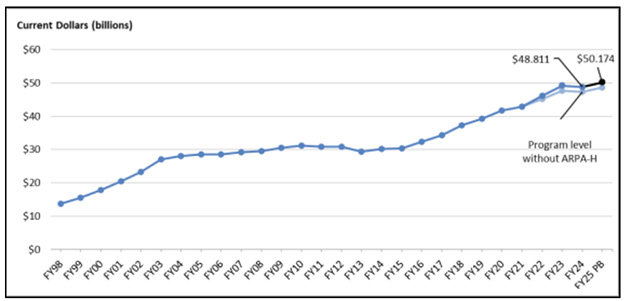
Turn Back the Clock? The NIH budget has climbed steadily since 1998, reaching $48.8 billion in 2024, with a proposed budget of $50 billion in 2025, prior to the recent grant terminations. The proposed FY2026 budget of $27 billion is on par with that of FY2003 (ARPA-H, Advanced Research Projects Agency, is an independent agency founded in FY2022). [Courtesy of Congress.gov.]
Funding for the National Institute on Aging, which supports much of ADRD research, has also climbed in recent years, from $2.5 billion in 2018 to $4.4 billion in 2024 to $4.5 billion in FY2025, prior to the cuts. At $2.68 billion, the proposed FY2026 budget would bring NIA funding close to FY2018 levels.
Funding for ADRD research, which is supported by several NIH agencies, has skyrocketed, from $589 million in FY2015 to $3.8 billion in 2024. Before any cuts, the projected budget for FY2025 topped $4 billion. With $3.98 billion penciled in for ADRD research in the proposed FY2026 budget, the field appears relatively shielded from the pending cuts.
However, AD research was not spared from grant terminations that have unfolded over the past few months. Some larger examples include a $51 million grant supporting the Diabetes Prevention Program Outcomes Study AD/ADRD project, a $22 million grant to learn about health, aging, and dementia in South Africa, and a $9.5 million grant funding research to enhance enrollment of underrepresented groups in AD registries.
These totals are approximations. For one thing, some of these cuts targeted not the parent grants but their diversity supplements, which provide support for individual students and postdocs who come from underrepresented racial or socioeconomic groups. These supplements generally run for two to five years, and are add-ons to much larger parent research grants, of which R01s are most common. The bread-and-butter of NIH grant funding, R01s provide multiyear support for research projects proposed by individual investigators.
Of the 909 R01s Grant Watch lists as terminated, 178 lost a diversity supplement, not the entire parent award. So, too, for 13 of the 44 AD-related R01s that are listed as having been cut. An additional seven were other types of supplements to parent R01s. Even so, in most cases, the value of the entire parent award is listed as terminated in Grant Watch. One example is a $5.5 million grant supporting research into sleep disturbances in AD, of which $983,416 had yet to be disbursed. While the parent award was listed as terminated, a closer look at the grant details reveals that the termination hit only a diversity supplement providing $98,828 in annual support for a single researcher. The parent R01 appears to remain active. At the time of publication, Alzforum was still awaiting confirmation from its principal investigator, Stanford University’s Andrea Goldstein-Piekarski. Grant Watch is working on correcting this discrepancy.
Lengthy and inconsistent delays in the government’s reporting of grant outlays, i.e. payment of funds to recipients, add another layer of imprecision to these numbers. These delays—which Alzforum found ranged from months to more than a year—result in an overestimation of remaining funds on a grant at the point it was terminated.
Besides shaving diversity supplements off larger research grants, stand-alone awards supporting training and research projects of individual students, postdocs, and early career investigators were slashed. Case in point: 31 of the 146 axed AD-related grants were Ruth L. Kirschstein National Research Service Awards that support predoctoral or postdoctoral scientists, and another 16 supported career transitions of individual postdocs and early investigators.
About 31 AD-related R01s were cancelled in full. So were eight RF1s, which differ from R01s in that all of their funding is dispensed up front, instead of year by year. Some of these research project grants were part of sweeping cuts directed at specific institutions such as Columbia or Harvard. Others were nixed due to the content of the research they supported, particularly if the projects centered on differences among ethnic, racial, gender, socioeconomic, or other demographic groups. For example, an $8 million grant supporting research about disparities in vascular dementia in rural and multicultural communities, led by scientists at the University of Miami, was cut.
Another example was an R01 titled “Establishing the science behind Alzheimer's recruitment registries: opportunities for increasing diversity and accelerating enrollment into trials.” This $9.5 million grant, of which $800,000 remained to be disbursed, supported a project led by Jessica Langbaum at Banner Alzheimer’s Institute in Phoenix. It aimed to identify ways to increase recruitment of men and people from underrepresented ethnic or racial groups into AD registries, which have tended to lean toward non-Hispanic white women. These registries, including the Alzheimer’s Prevention Registry, GeneMatch, and the Brain Health Registry, source potential participants for prevention trials. Through national surveys, interviews, and focus groups, Langbaum’s study was in the process of learning how to draw more men and minorities into the registries, with the goal of increasing their representation in clinical trials. The study was in its last year when it was terminated, and Langbaum told Alzforum that the funding shutoff will hinder efforts to analyze the findings and put them to use.
Langbaum has appealed the termination, but has yet to receive a response.
At least one AD-related, large multicenter grant—a $51 million award supporting the Diabetes Prevention Program Outcomes Study AD/ADRD project—fell prey to the March wave of terminations targeting Columbia University. The 25-site clinical study, led by Columbia’s Jose Luchsinger, aims to understand the relationship between prediabetes/Type 2 diabetes with AD and related disorders. Luchsinger told Alzforum that he is working on solutions to the funding loss, and declined to comment further.
There have been some reinstatements. Charles DeCarli, University of California, Davis, won back $36 million for his multicenter project investigating the clinical significance of cerebrovascular pathology in an ethno-racially diverse cohort. The word “diverse” may have initially relegated this study to the DEI dustbin.
In March, DeCarli received the same DEI-related cancellation notice that Langbaum had. It stated that “Research programs based primarily on artificial and nonscientific categories, including amorphous equity objectives, are antithetical to the scientific inquiry, do nothing to expand our knowledge of living systems, provide low returns on investment, and ultimately do not enhance health, lengthen life, or reduce illness.” This surprised DeCarli, given that the NIH itself had been insisting for some years that studies enroll populations at highest risk for dementia. With the help of lawyers, DeCarli appealed the termination, and the grant was reinstated just in time to continue follow-up studies.
The funding halt for DEI-related studies relates to an executive order President Trump issued in his first weeks after taking office. Yet scientists who spoke with Alzforum had different views of what falls under the DEI umbrella. For example, while Langbaum’s terminated grant aimed to learn more about what keeps different demographic groups from joining registries, other studies that aim directly to boost enrollment of similar groups have remained untouched. The Alzheimer’s Disease Neuroimaging Initiative (ADNI) is an example. Now in its fourth iteration—ADNI4—the landmark observational study has adapted its outreach and engagement strategies to enroll a more diverse population of participants (Oct 2022 news), most recently shifting toward educational and economic deprivation and other so-called social determinants of health. So far, the $147 million NIH grant supporting this ongoing study remains intact. “ADNI4 is not DEI—it’s about improving the generalizability of clinical research,” ADNI leader Michael Weiner of the University of California, San Francisco, told Alzforum.
Langbaum views the goals of her terminated study similarly: namely, to include people in AD clinical studies who reflect the demographics of those affected by the disease. As opposed to the ADNI4 grant, which covers the entire study, Langbaum’s terminated R01 supported learning about recruitment strategies for underrepresented groups.
Still other Alzheimer researchers view “DEI” as applying less to the research itself, and more to the way staff, students, postdocs, and other scientists are hired and supported. Programs that seek to enhance the diversity of the scientific workforce, such as diversity supplements, fall into this category.
Grant Watch leader Delaney breaks these DEI-related terminations into two camps: one targeting the science, the other targeting the scientists. Neither type of termination is absolute. For example, Delaney said that half of NIH grants with the word “transgender” in their description were terminated; the other half survived. Delaney said he discerned no rhyme or reason behind which ones were cancelled and which were left alone.
Beyond terminations, funding freezes and delays have also been wreaking havoc on AD research. For more on how those are affecting AD research, see next story.—Jessica Shugart
References
News Citations
Other Citations
External Citations
Further Reading
No Available Further Reading
Annotate
To make an annotation you must Login or Register.
Comments
No Available Comments
Make a Comment
To make a comment you must login or register.