
Brand-New Biomarker for Alzheimer’s: Circulating, Circular RNA
Quick Links
Ring-shaped RNAs floating in a person’s bloodstream might mean bad news for their brain. At the 18th Clinical Trials on Alzheimer’s Disease, held December 1–4 in San Diego, Bridget Phillips, a graduate student in the laboratory of Carlos Cruchaga at Washington University in St. Louis, reported that a select panel of these durable RNA loops can pick out who is at risk of developing Alzheimer’s symptoms even better than does p-tau217. A clinical blood test based on this approach is in development.
- Scientists identify a panel of annular RNAs that are increased in the blood of people with Alzheimer’s disease.
- This panel enabled the scientists to build a diagnostic model.
- In two separate cohorts, the model predicted who was more likely to develop Alzheimer’s symptoms within five years.
- It outperformed pTau217.
Circular RNAs, or “circRNAs,” form when RNA is back-spliced—that is, when its 3' and 5' ends fuse into a covalently closed loop. This unusual structure renders them remarkably resilient, as exonucleases that readily chew through linear RNA strands can’t easily get at them. One cellular function of these hoop-like RNAs? They regulate gene expression by sopping up free-floating microRNAs to prevent them from silencing their gene targets. CircRNAs appear in most cell types but are especially enriched in the brain, where they build up at neuronal synapses (Hanan et al., 2017).
Though still a matter of speculation, some scientists suspect that synapses may release circRNAs as part of normal cell-to-cell communication, or during cell death or disease. Crucially, the blood–brain barrier puts up little impediment to circRNAs slipping into the circulation. This makes them attractive candidates for biomarkers. Indeed, researchers have explored their use in detecting signs of stroke, depression, Parkinson’s disease, and now Alzheimer’s disease (Zhang et al., 2023; Zhang et al., 2022; Beric et al., 2024).
“The death of neurons in AD brains could provide the source of circRNAs that penetrate the BBB and circulate in the blood,” Dingding Mo of Beijing Lighting-Brain Therapeutics, a start-up based in China, told Alzforum. Mo studies how circRNAs may drive Aβ plaque accumulation (Mo et al., 2025).
Previous work from the Cruchaga lab analyzed parietal cortex tissue from Alzheimer’s brains and found that many circRNAs closely tracked with the severity of dementia symptoms at the time of death (Dube et al., 2019; Oct 2019 news). Now, the group is asking whether this Alzheimer’s signature also appears in the blood.
For their investigation, Phillips and colleagues turned to RNA-Seq data from blood samples collected at the Knight Alzheimer Disease Research Center at Washington University. From a cohort of 405 people with Alzheimer’s and 829 cognitively unimpaired controls, the team recovered about 1,600 circRNAs that passed quality control. Of these, 203 were nominally associated with an Alzheimer’s diagnosis, and 34 survived multiple-testing correction—all of them elevated in Alzheimer’s versus controls.
Armed with this circRNA panel, the researchers then built a model that was able to guess who had been diagnosed with Alzheimer’s disease with fairly good accuracy—an AUC of 0.77.
This, by itself, isn’t particularly useful, but it set up the real test: Could the same model predict who might go on to develop Alzheimer’s among cognitively healthy persons? Thanks to years of follow-up in the Knight ADRC, the scientists had data from 78 participants who had been cognitively normal at the time of their blood draw but later developed clinical symptoms of Alzheimer’s dementia. They found that individuals the model flagged as having a higher circRNA signature were nearly three times more likely to develop Alzheimer’s. Over a five-year window, the circRNA model even bested p-tau217, for which positive participants were only about twice as likely to be diagnosed.
To validate their results, Phillips turned to the A4 dataset, a prevention trial started in 2014 that enrolled more than 1,700 cognitively unimpaired adults aged 65 to 85 who had elevated amyloid on screening PET scans and were therefore at increased risk of cognitive decline. When the team applied their model to this cohort, people with higher circRNA signatures turned out to have been almost twice as likely to progress to symptomatic Alzheimer’s as those flagged by p-tau217, echoing the findings from the Knight-ADRC cohort (image below).
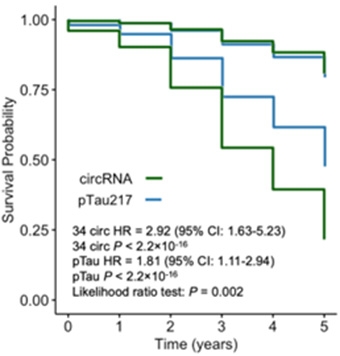
CircRNAs Call It Early. In the A4 prevention trial cohort, participants positive for elevated circRNAs progressed to symptomatic Alzheimer’s at higher rates than those flagged by p-tau217. [Courtesy of Carlos Cruchaga.]
“P-tau217 is a great marker for pathology and one the field has really embraced,” Cruchaga told AlzForum. “The issue is that it can change decades before onset, so there’s no way to know when someone will actually develop disease.” By contrast, he said, the circRNA signature appears to be more tightly linked to imminent decline. “The circular RNAs can more accurately stratify who is going to get disease or not,” Cruchaga noted. “If you are running a clinical trial, that might mean a 50 percent lower sample size.”
Cruchaga is actively collaborating with the San Diego–based startup Circular Genomics, which he said is interested in licensing his team’s discovery to develop clinical assays. In the fall of 2024, the company launched its first product—a blood test that measures circular RNAs in people with depression to help predict their likelihood of responding to selective serotonin reuptake inhibitor drugs. On December 1 of this year, Circular Genomics announced that it had closed a $15 million Series A round, with participation from the Alzheimer’s Drug Discovery Foundation, to adapt its circRNA blood test platform for use in Alzheimer’s disease.
"As with any new biomarker technology, it will be important to evaluate these biomarkers in real-world clinical populations to see how they perform,” Timothy Hohman of Vanderbilt University in Nashville, Tennessee, told Alzforum. Hohman collaborates with Cruchaga and serves on the scientific advisory board of Circular Genomics. He noted a challenge: the need for specialized tubes that stabilize these RNAs at collection to ensure accurate measurement. “These would need to be built into routine clinical workflows to move this technology into the clinic,” he said.—George R. Heaton
George Heaton is a freelance writer in Durham, North Carolina.
References
News Citations
Paper Citations
- Hanan M, Soreq H, Kadener S. CircRNAs in the brain. RNA Biol. 2017 Aug 3;14(8):1028-1034. Epub 2016 Nov 28 PubMed.
- Zhang X, Wan M, Min X, Chu G, Luo Y, Han Z, Li W, Xu R, Luo J, Li W, Yang Y, Ma Y, Jiao L, Wang T. Circular RNA as biomarkers for acute ischemic stroke: A systematic review and meta-analysis. CNS Neurosci Ther. 2023 Aug;29(8):2086-2100. Epub 2023 Apr 26 PubMed.
- Zhang D, Ji Y, Chen X, Chen R, Wei Y, Peng Q, Lin J, Yin J, Li H, Cui L, Lin Z, Cai Y. Peripheral Blood Circular RNAs as a Biomarker for Major Depressive Disorder and Prediction of Possible Pathways. Front Neurosci. 2022;16:844422. Epub 2022 Mar 31 PubMed.
- Beric A, Sun Y, Sanchez S, Martin C, Powell T, Kumar R, Pardo JA, Darekar G, Sanford J, Dikec D, Phillips B, Botia JA, Cruchaga C, Ibanez L. Circulating blood circular RNA in Parkinson's Disease; from involvement in pathology to diagnostic tools in at-risk individuals. NPJ Parkinsons Dis. 2024 Nov 18;10(1):222. PubMed.
- Mo D, Zhao Y, Liu Y, Brosius J, Xiao G. circAβ-a RNA encoded Aβ175--the hidden driver of β-amyloid plaque formation and deposition in sporadic Alzheimer's disease. 2025 Jan 18 10.1101/2025.01.18.633698 (version 1) bioRxiv.
- Dube U, Del-Aguila JL, Li Z, Budde JP, Jiang S, Hsu S, Ibanez L, Fernandez MV, Farias F, Norton J, Gentsch J, Wang F, Dominantly Inherited Alzheimer Network (DIAN), Salloway S, Masters CL, Lee JH, Graff-Radford NR, Chhatwal JP, Bateman RJ, Morris JC, Karch CM, Harari O, Cruchaga C. An atlas of cortical circular RNA expression in Alzheimer disease brains demonstrates clinical and pathological associations. Nat Neurosci. 2019 Nov;22(11):1903-1912. Epub 2019 Oct 7 PubMed.
External Citations
Further Reading
No Available Further Reading
Annotate
To make an annotation you must Login or Register.
Comments
Vanderbilt Memory & Alzheimer's Center
I joined the scientific advisory board for Circular Genomics because of the potential for clinical screening. More specifically, I am interested in the potential for circular RNAs to act as peripheral biomarkers of brain-specific disease processes. The data from the Cruchaga lab demonstrate that circular RNAs change in the human brain during disease, and that those changes can be measured using a blood-based biomarker assay, providing a clear demonstration that there is a path forward for RNA-based blood biomarkers. I think we as a field are just beginning to scratch the surface in this space, so I'm excited to see where this technology goes from here. The current data provide evidence that these circular RNAs can predict future progression to clinical Alzheimer's disease dementia, and I am hopeful that they may also be useful in characterizing disease subtypes to help move the field toward precision interventions.
As with any new biomarker technology, and as mentioned in the circular genomics press release that you bring up, it will be important to evaluate these biomarkers in real-world clinical populations to see how they perform. There are also important challenges, such as the need for specialized tubes for sample acquisition that will stabilize the RNAs for measurement. Many of the centers focused on Alzheimer's disease already collected samples in some of these tubes, but it would need to become part of a clinical workflow to move these technologies into the clinic.
Make a Comment
To make a comment you must login or register.