
At CTAD: More Hints That Shingles Shot Staves Off Dementia
Quick Links
Epidemiological suggestions that the shingles vaccine might protect against dementia keep rolling in. Pascal Geldsetzer, Stanford University, presented his group’s latest findings at this year’s Clinical Trials on Alzheimer’s Disease Conference, held December 1-4 in San Diego. Vaccination against Herpes zoster (HZ) appears to train the immune system to ward off dementia in a third study cohort, results to be published by the end of the year. This follows two similar reports this past spring, Beyond that, Geldsetzer also showed data at CTAD indicating that the vaccine might shield against the full scope of dementia, including mild cognitive impairment (MCI) and death due to dementia. This data appeared December 2 in Cell.
- Canada joins the list of areas where the shingles vaccine appears to lower dementia diagnoses.
- In the UK, vaccination appears to hold at bay MCI and death due to dementia.
- Next step: a randomized clinical trial?
“If these are true causal effects, it would have huge implications for population health and dementia research,” Geldsetzer told the CTAD audience.
Geldsetzer’s approach makes use of public health policies for HZ vaccine rollout and electronic health records to construct a pseudo-randomized "trial." He debuted his method earlier this year by showing that vaccinated members of a cohort in Wales were 20 percent less likely to develop dementia than their unvaccinated peers. Less than a month later, he published corroboration of these findings in Australians whose vaccination eligibility was similarly dictated by a birth cutoff set by their public health system (Apr 2025 news; May 2025 news).
Unlike classic observational association studies, this method overcomes the bias that people who opt to be vaccinated tend to differ from those who do not in a variety of ways that are not captured and may confound results, Geldsetzer emphasized at the conference.
After Wales and Down Under, the scientists turned their gaze to Ontario, the only province in Canada that has dictated HZ vaccination eligibility by age. For one rollout that kicked off on September 15 of 2016, only citizens born after 1944—aged 72 years or older—were eligible to receive the live-attenuated vaccine Zostavax. Lo and behold, it protected them from dementia to a similar degree as seen in the Welsh and Australian cohorts, Geldsetzer shared.
That no other Canadian province issued the same policy was a lucky break for the researchers’ analysis. It allowed them to compare the rate of new dementia cases in eligible vaccine recipients in Ontario to that of all other Canadians, who were not. These two groups’ respective dementia incidence aligned almost perfectly up until the 2016 vaccine deployment. From there, the rate of new dementia cases diverged, with vaccine-eligible Ontarians largely protected. Once again, this finding implies that an immediate intervention—vaccine exposure—drove the effect rather than demographic confounds.
“What makes our research exciting is that we see the same protective effect from shingles vaccination for dementia in dataset after dataset—in different populations and different countries that rolled out the vaccine in a similar way as Wales did,” Geldsetzer wrote to Alzforum.
The complete study in this Canadian population is in press at The Lancet Neurology.
Geldsetzer then told the CTAD audience about his team’s most recent paper, which suggests that the HZ vaccine may reduce risk across other aspects of the disease, not just clinical dementia diagnosis. Their studies in Wales and Australia focused solely on such diagnoses, not on disease stages.
This time, the authors expanded their health record exploration to include MCI diagnoses and the number of deaths due to dementia in the Wales cohort, showing that HZ vaccination may guard against the entire disease course. They performed two complementary analyses—of the onset of MCI in initially unimpaired people, and of mortality due to dementia among the diagnosed.
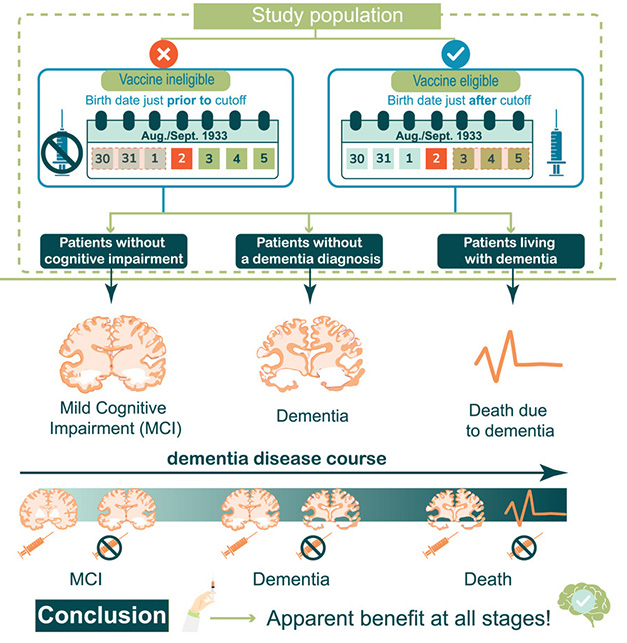
Pan Protection? People eligible for the shingles vaccine appeared protected across the symptomatic disease course. [Courtesy of Xie et al., 2025, Cell.]
Over nine years following the September 1, 2013, rollout, 20,713 of the 282,557 initially healthy group, or 7.3 percent, developed MCI. Healthy people born after September 2, 1933—i.e., the eligible ones—had a 1.5 percentage point lower risk of being diagnosed with MCI. When adjusting for the actual number of eligible individuals who received the vaccine, the protective effect rose to 3.1 percentage points. In other words, for 10 out of 100 unvaccinated people who developed MCI, seven out of 100 vaccinated people did.
At the other end of the disease course, 7,049 of the 14,350 people with dementia at baseline, or 49.1 percent, died of the disease. Vaccine-eligible people with AD had 8.5 percentage points fewer deaths due to dementia; actual vaccine receipt brought this to a 29.5 point reduction.
“It’s not that we are just averting deaths from dementia for these individuals to die from other causes,” Geldsetzer told CTAD. “We see a reduction as well in all-cause mortality among people who already had dementia at the start of the zoster vaccination program, meaning we are increasing remaining life expectancy among these individuals.”
Geldsetzer is currently fundraising for a randomized clinical trial to test his hypothesis. “Ideally, such a trial would use the old, live-attenuated vaccine which was the subject of our natural experiments,” Geldsetzer said to the audience. He told Alzforum that such a trial would sample from the general, aged population and would follow participants over four years.—Anna Bright
Anna Bright is a Ph.D. student in New York City.
References
News Citations
Further Reading
Primary Papers
- Xie M, Eyting M, Bommer C, Ahmed H, Geldsetzer P. The effect of shingles vaccination at different stages of the dementia disease course. Cell. 2025 Dec 11;188(25):7049-7064.e20. Epub 2025 Dec 2 PubMed.
Annotate
To make an annotation you must Login or Register.
Comments
No Available Comments
Make a Comment
To make a comment you must login or register.