
Can Sealing Burst Membranes Slow Alzheimer’s Disease Pathology?
Quick Links
In Alzheimer’s, and in mouse models of the disease, axon membranes bleb up in the vicinity of amyloid plaques. What if there was a way to prevent these dystrophic neurites from forming? As reported in the May 24 Acta Neuropathologica, annexin A6 might do the trick. When scientists led by Robert Vassar, Northwestern University, Chicago, added this membrane-repair protein into the brains of mice, it found the damaged membranes. There, it brought down the swellings and tempered production of phospho-tau181, an early marker of amyloid and tangle pathology. Vassar thinks annexin A6 has therapeutic potential.
- In AD, dystrophic neurites amass calcium, which activates annexin A6.
- In mice, A6 calmed axonal membranes and tempered tau phosphorylation.
- An inactive A6 variant worsened pathology.
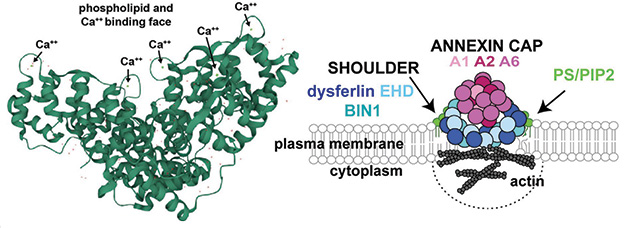
Annexin A6 belongs to a family of phospholipid-binding proteins that repair and remodel cell membranes (image below). Previously, Vassar and colleagues had found that A6 rapidly latches onto neuronal membranes that have been damaged by heating them with a laser (Demonbreun et al., 2022). Might the protein also seek out dystrophic neurons in AD? Indeed, when first author Katherin Sadleir and colleagues overexpressed annexin 6 in two different strains of 5xFAD mice, it wormed its way into dystrophic neurites that had accumulated amyloid precursor protein and β-secretase (image below). Endogenous annexin A6 also decorated these neurites in 5xFAD mice, NL-G-F APP knock-in mice, and in human AD brain samples.
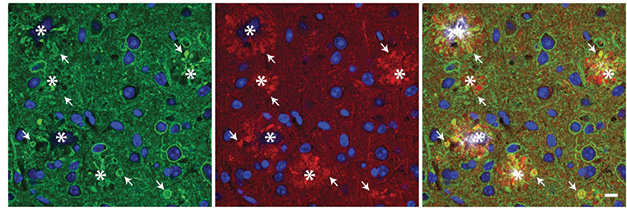
Find The Neurites. In 5xFAD mice, AAV-driven annexin 6 (green) finds its way to plasma membranes (left) and to BACE-laden (red) neurites (center) adjacent to amyloid plaques (white). White arrows point to dystrophic neurites (right). [Courtesy of Sadleir et al., Acta Neuropathologica, 2025.]
Looking downstream, Sadleir took stock of tau pathology markers. Mice overexpressing the annexin made less p-tau181 than did control 5xFAD animals, while those expressing the dominant-negative version produced more. The scientists found that dystrophic neurites in the mice harbored activated CaMKII and JNK, two kinases known to phosphorylate tau. Calpain, a tau protease, also accumulated there. All told, the data support the idea that dystrophic neurites, which form in response to amyloid toxicity, provide an environment ripe for propagating tau pathology, and that annexin 6 can tone this down.

Annexin Therapy? When injected into the brains of APP NL-G-F mice, recombinant annexin A6 (green) concentrated near amyloid plaques (blue) where it bound membranes surrounding BACE1 (red). [Courtesy of Sadleir et al., Acta Neuropathologica, 2025.]
To test this idea, the scientists injected recombinant annexin A6 into the lateral ventricles in the brains of 5xFAD and NL-G-F mice. Far from the injection site, the annexin bound the membranes of dystrophic neurites, coating some of them (image above). The data demonstrate, as a proof of concept, that extracellular A6 can target damaged membranes near amyloid plaques, wrote the authors. Vassar told Alzforum that he is interested in this as a therapy for AD. “We are exploring exogenous administration of recombinant A6, which has been shown to repair membrane injury in muscle cells, even when applied extracellularly,” he wrote.—Tom Fagan
References
Research Models Citations
Paper Citations
- Demonbreun AR, Bogdanovic E, Vaught LA, Reiser NL, Fallon KS, Long AM, Oosterbaan CC, Hadhazy M, Page PG, Joseph PR, Cowen G, Telenson AM, Khatri A, Sadleir KR, Vassar R, McNally EM. A conserved annexin A6-mediated membrane repair mechanism in muscle, heart, and nerve. JCI Insight. 2022 Jul 22;7(14) PubMed.
Further Reading
No Available Further Reading
Primary Papers
- Sadleir KR, Gomez KP, Edwards AE, Patel AJ, Ley ML, Khatri AW, Guo J, Mahesh S, Watkins EA, Popovic J, Karunakaran DK, Prokopenko D, Tanzi RE, Bustos B, Lubbe SJ, Demonbruen AR, McNally EM, Vassar R. Annexin A6 membrane repair protein protects against amyloid-induced dystrophic neurites and tau phosphorylation in Alzheimer's disease model mice. Acta Neuropathol. 2025 May 24;149(1):51. PubMed.
Annotate
To make an annotation you must Login or Register.
Comments
No Available Comments
Make a Comment
To make a comment you must login or register.