
That Dirty Air? It May Worsen Alzheimer’s and Lewy Body Pathology
Quick Links
Polluted air leaves its mark on the brain. In the September 8 JAMA Neurology, Edward Lee and colleagues at the University of Pennsylvania, Philadelphia, report that two decades of autopsies reveal a pattern: People who lived amid higher levels of fine-particle pollution died with a heavier load of plaques and tangles. The paper appeared shortly after one in the September 4 Science tied air pollution to risk of Lewy body dementia. The authors, led by Xiao Wu of Columbia University, New York, with Ted Dawson, Shizhong Han, and Xiaobo Mao at Johns Hopkins, Baltimore, went beyond epidemiology, reporting that fine particulate matter itself can cause α-synuclein to assemble into pathogenic fibrils. Together, the two papers strengthen the evidence linking pollution to pathology.
- A study tied PM2.5 particulates to Alzheimer’s pathology at autopsy.
- Another found they raise risk of Lewy body dementia.
- In mice and in vitro, PM2.5 induces α-synuclein aggregation.
Diesel engines, coal-burning factories, wildfires, and other sources spew tiny particles into the air. The U.S. Environmental Protection Agency categorizes them into coarse particles, or PM10, measuring 2.5 to 10 micrometers across, and the fine stuff, PM2.5, at 2.5 micrometers or smaller. Scientists worry most about the latter, which are small enough to be inhaled deep into the lungs, slip into the bloodstream, and reach the brain. Evidence suggests they also get into the brain via the olfactory nerves in the nose.
Epidemiological links between such miasma and dementia risk have been known for many years, but scientists are now finding that it may also hasten the buildup of underlying pathology (May 2020 news; Jan 2017 news; Dec 2022 news).
The first clues of this came from Mexico City, where pollution is notoriously high. Lilian Calderón-Garcidueñas and colleagues at the University of Montana, Missoula, examined the olfactory bulbs of children and young adults who had lived their lives there. Most bore Aβ plaques, and a few also showed α-synuclein pathology. Controls from outside the metropolitan hubbub had no such changes (May 2020 news; Calderón-Garcidueñas et al., 2010). In a follow-up study, the group again analyzed olfactory bulbs from Mexico City residents under 20, finding that most carried hyperphosphorylated tau as well as aggregates of Aβ and α-synuclein (Calderón-Garcidueñas et al., 2018).
Similarly, in Atlanta, Anke Hüls and colleagues at Emory University found that healthy adults exposed to fine particulate matter (PM2.5), based on residential history, had less Aβ42 in their cerebrospinal fluid than did people living in less-polluted areas—an indication the peptide is accumulating in the brain (Casey et al., 2024). Researchers led by Jin-Tai Yu at Fudan University, Shanghai, likewise reported that higher PM2.5 exposure in China tracked with lower CSF Aβ42/Aβ40 ratios in older adults (Ma et al., 2022).
John Morris and colleagues at Washington University in St. Louis recently trialed a new approach, equipping 59 volunteers with personal air-quality sensors, rather than relying on region-level estimates. They found that PM2.5 correlated positively with total tau in CSF, and exposure to volatile organic compounds weakly correlated with lower CSF Aβ42/40 and higher Aβ40, though, the authors emphasize that this was a small study and would need to be repeated with a larger sample size before drawing any strong conclusions (Xiong et al., 2025).
Scientists have also linked dirty air to Alzheimer’s pathology in the brain itself. Using amyloid PET, Gil Rabinovici and colleagues at the University of California, San Francisco, found that higher PM2.5 exposure in the U.S.—estimated from participants’ ZIP codes—was associated with greater plaque burden in a nationwide cohort of older adults with mild cognitive impairment or dementia (Dec 2020 news; Iaccarino et al., 2021).
However, postmortem studies have been equivocal. In 2021, Lianne Sheppard and colleagues at the University of Washington, Seattle, examined autopsy samples from participants in the Adult Changes in Thought study, a Seattle-based cohort of people 65 and older recruited through a local health maintenance organization. Among 832 autopsies, higher long-term PM2.5 exposure showed but a nonsignificant trend toward more amyloid plaques, and no association with tau tangles. The authors noted that most participants had relatively low 10-year PM2.5 exposures, which may have limited their ability to detect associations (Shaffer et al., 2022). On the other hand, Hüls and colleagues studied 224 brain donors from the Atlanta area and found that higher PM2.5 exposure up to three years before death significantly associated with amyloid plaques. For tau pathology, there was a trend, but it did not reach statistical significance (Christensen et al., 2024).
Against this backdrop, Lee and colleagues drew on autopsy tissue collected between 1999 and 2022 from donors across California, Colorado, Connecticut, Delaware, Maryland, New Jersey, New York, Ohio, Virginia, and West Virginia, though most came from Pennsylvania. In total, 602 individuals were included. About half had been diagnosed with possible or probable Alzheimer’s disease, 85 with Parkinson’s disease dementia, 37 with Parkinson’s disease without dementia, and 51 with dementia with Lewy bodies. There were 32 frontotemporal dementia cases and a small number diagnosed with a range of rare neurodegenerative conditions. Twenty-eight were neurologically normal at their last clinical visit. Men and women were equally represented and the median age at death was 78. Most were white and had a college degree.
First author Boram Kim and colleagues found that more than 70 percent of brains contained widespread Aβ plaques, and nearly two-thirds had extensive neurofibrillary tangles. In total, 62 percent were judged to have high levels of Alzheimer’s disease neuropathology.
Alongside this, scientists estimated air quality from 1998 to 2022 using prediction models developed based on ground measurements and remote satellite sensing (van Donkelaar et al., 2021). Kim then matched this data to where participants had lived to quantify an individual’s PM2.5 exposure in the year prior to their death.
In their cohort, the median PM2.5 exposure was 9.4 µg/m³. For comparison, the U.S. national average hovers around 7–8 µg/m³ per year, with the cleanest air flowing over the Pacific Northwest and northern New England, which clock in at around 3 µg/m³. Some U.S. metro areas average 12 µg/m³ per year, or higher. The World Health Organization’s air quality guidelines stipulate annual averages should not exceed 5 µg/m³.
Kim and colleagues found that higher PM2.5 exposure in the year before death was linked to greater odds of severe Alzheimer’s pathology, with each 1 µg/m³ uptick corresponding to 17 percent higher odds of higher amyloid Thal phase and 20 percent higher chance of being in a more advanced Braak stage for tau pathology.
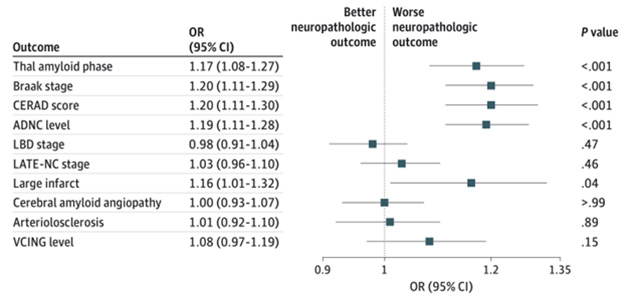
Pollution and Pathology. Odds ratios for each neuropathologic outcome per 1 μg/m³ rise in annual PM2.5 exposure before death. [Courtesy of Kim et al., JAMA Neurology, 2025.]
Why did this study detect an association with tau pathology that earlier ones had not? The authors note that their postmortem cohort—unlike previous ones—consisted mainly of symptomatic dementia cases enriched for AD. This greater homogeneity probably yielded statistical power to detect AD-specific effects. They found no correlation with other brain pathologies, including cerebral amyloid angiopathy (Aβ), LATE neuropathology (TDP-43), or what stage of Lewy body dementia (α-synuclein) pathology a person had.
“These human data are invaluable—they suggest pollution may not only raise dementia risk epidemiologically, but also accelerate the underlying pathology,” said Mao, who did find a link between PM2.5 and Lewy body dementia.
In that study, first authors Xiaodi Zhang, Haiqing Liu, and Longgang Jia at Johns Hopkins, and Xiao Wu at Columbia, and colleagues analyzed Medicare hospital records from 2000 to 2014 for 56.5 million people aged 65 and older, to identify the first time anyone received one of four α-synucleinopathy diagnoses: Parkinson’s disease, Parkinson’s disease without dementia, Parkinson’s disease dementia, or dementia with Lewy bodies. The scientists estimated long-term PM2.5 exposure based on residential ZIP codes. They found that the higher the levels the likelier someone would be hospitalized for any of the four disorders, with the strongest effects seen for Parkinson’s disease dementia and dementia with Lewy bodies.

Pollution and Synucleinopathies. Average U.S. PM2.5 concentrations in μg/m³ from 2000 to 2014 (left) maps to first hospital admissions rates for synucleinopathies over the same period. [Courtesy of Zhang et al., Science, 2025.]
How might pollution increase risk? To investigate, the scientists turned to mouse models. They sprayed PM2.5 particulate matter into the animals’ nasal passages. The soot had been collected between 2011 and 2013 in Baoji, Shaanxi, China, using a rooftop sampler at the municipal environmental protection bureau. PM2.5 was captured on filter paper, extracted, and resuspended in saline buffer. When wild-type mice were treated every other day for 10 months, their temporal lobes and hippocampi thinned while their brain ventricles enlarged. Inclusions containing pS129 α-synuclein cropped up in the hippocampus, dentate gyrus, and parietal cortex, as well as throughout the gastrointestinal tract. By contrast, α-synuclein knockout mice were largely spared, showing no inclusions or structural brain changes.
Did the particulate matter affect the protein directly? To find out, Zhang and colleagues incubated recombinant human α-synuclein monomers with or without PM2.5 for one week to generate fibrils. Thioflavin T fluorescence revealed that PM2.5-induced preformed fibrils (PM-PFFs) were more β-sheet–rich than control PFFs. On dot blots they were more resistant to proteinase K digestion.
To test pathogenicity of these fibrils, Zhang injected PM-PFFs or control PFFs into the dorsal striatum of two-month-old humanized α-synuclein mice, then examined the brains four months later. In the substantia nigra, where Parkinson’s disease pathology decimates neurons, PM-PFFs had seeded fewer pS129-positive deposits than had regular PFFs. In the cortex PM-PFFS had spurred three times more pS129 pathology than control PPFS (image below). The findings hint that PM-PFFs may be more like fibrils found in LBD than those found in PD.
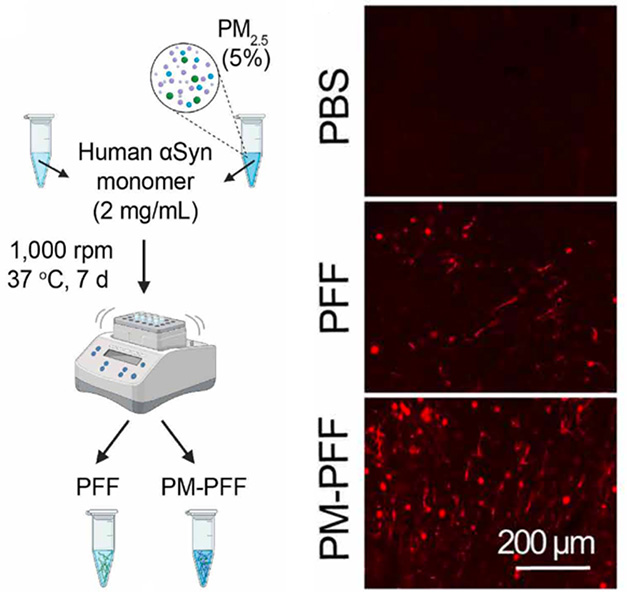
Pollution Primes Fibrils. Captured particulates were suspended in solution and incubated with human α-synuclein monomers to generate PM-PFFs (left). Injected into the striatum of humanized α-synuclein mice (right), PM-PFFs induce more pS129 pathology (red, bottom) than do conventional PFFs (middle). Buffered saline was a control (top). [Courtesy of Zhang et al., Science, 2025.]
“Both Lee’s study and our work provide convergent evidence that air pollution can directly promote pathologically relevant protein aggregation in the brain,” Dawson told Alzforum.
Other scientists had concerns, noting that the study omits high-resolution structural analysis, such as NMR or cryo-EM, of the PM-derived fibrils, making independent replication of these results difficult. Some wondered how the increase in fibril seeding the authors documented relates to the modest increases in risk for LBD attributed to pollution.
For his part, Lee praised Mao et al.’s study for its blend of epidemiological and mechanistic approaches. “The use of complementary disciplines adds to the richness of evidence that supports the hypothesis that ambient air pollution negatively affects brain health,” Lee told Alzforum. He also noted that while Mao’s group linked PM2.5 exposure to synucleinopathies, his own study did not find that. Since Lee’s study focused on Lewy body disease staging, it may not have captured the full burden of α-synuclein pathology, he said.
Dawson hopes people will pay more attention to how pollution affects proteinopathies as more mechanistic, autopsy, and interventional data emerges. Mao was optimistic, saying, “I anticipate rapid progress in the next one to two years, as more groups integrate epidemiological cohorts with molecular and mechanistic studies.”—George R. Heaton
George Heaton is a freelance writer in Durham, North Carolina.
References
News Citations
- Air Pollution and Dementia—Through Hazy Data, Links Emerge
- Dementia Risk Ticks Up Near Major Roadways
- Living in Greener Pastures May Cut Risk for Alzheimer’s, Parkinson’s
- The Air We Breathe—How Might Pollution Hurt the Brain?
- You Are What You Breathe: Polluted Air Tied to Plaques, Brain Atrophy
Paper Citations
- Calderón-Garcidueñas L, Franco-Lira M, Henríquez-Roldán C, Osnaya N, González-Maciel A, Reynoso-Robles R, Villarreal-Calderon R, Herritt L, Brooks D, Keefe S, Palacios-Moreno J, Torres-Jardón R, Medina-Cortina H, Delgado-Chávez R, Aiello-Mora M, Maronpot RR, Doty RL. Urban air pollution: influences on olfactory function and pathology in exposed children and young adults. Exp Toxicol Pathol. 2010 Jan;62(1):91-102. PubMed.
- Calderón-Garcidueñas L, González-Maciel A, Reynoso-Robles R, Kulesza RJ, Mukherjee PS, Torres-Jardón R, Rönkkö T, Doty RL. Alzheimer's disease and alpha-synuclein pathology in the olfactory bulbs of infants, children, teens and adults ≤ 40 years in Metropolitan Mexico City. APOE4 carriers at higher risk of suicide accelerate their olfactory bulb pathology. Environ Res. 2018 Oct;166:348-362. Epub 2018 Jun 20 PubMed.
- Casey E, Li Z, Liang D, Ebelt S, Levey AI, Lah JJ, Wingo TS, Hüls A. Association between Fine Particulate Matter Exposure and Cerebrospinal Fluid Biomarkers of Alzheimer's Disease among a Cognitively Healthy Population-Based Cohort. Environ Health Perspect. 2024 Apr;132(4):47001. Epub 2024 Apr 3 PubMed.
- Ma YH, Chen HS, Liu C, Feng QS, Feng L, Zhang YR, Hu H, Dong Q, Tan L, Kan HD, Zhang C, Suckling J, Zeng Y, Chen RJ, Yu JT. Association of Long-term Exposure to Ambient Air Pollution With Cognitive Decline and Alzheimer's Disease-Related Amyloidosis. Biol Psychiatry. 2022 May 18; PubMed.
- Xiong C, Lu R, Bui Q, Popp B, Schindler SE, Shriver LP, Cruchaga C, Hassenstab J, Benzinger TL, Agboola F, Gremminger E, Streitz ML, Hall C, Moulder KL, Morris JC. Person-specific digital measurements of air pollutant exposure and biomarkers of Alzheimer's disease: Findings from a pilot study. J Alzheimers Dis. 2025 Sep;107(2):778-788. Epub 2025 Sep 1 PubMed.
- Iaccarino L, La Joie R, Lesman-Segev OH, Lee E, Hanna L, Allen IE, Hillner BE, Siegel BA, Whitmer RA, Carrillo MC, Gatsonis C, Rabinovici GD. Association Between Ambient Air Pollution and Amyloid Positron Emission Tomography Positivity in Older Adults With Cognitive Impairment. JAMA Neurol. 2021 Feb 1;78(2):197-207. PubMed.
- Shaffer RM, Li G, Adar SD, Dirk Keene C, Latimer CS, Crane PK, Larson EB, Kaufman JD, Carone M, Sheppard L. Fine Particulate Matter and Markers of Alzheimer's Disease Neuropathology at Autopsy in a Community-Based Cohort. J Alzheimers Dis. 2021;79(4):1761-1773. PubMed.
- Christensen GM, Li Z, Liang D, Ebelt S, Gearing M, Levey AI, Lah JJ, Wingo A, Wingo T, Hüls A. Association of PM2.5 Exposure and Alzheimer Disease Pathology in Brain Bank Donors-Effect Modification by APOE Genotype. Neurology. 2024 Mar 12;102(5):e209162. Epub 2024 Feb 21 PubMed.
- van Donkelaar A, Hammer MS, Bindle L, Brauer M, Brook JR, Garay MJ, Hsu NC, Kalashnikova OV, Kahn RA, Lee C, Levy RC, Lyapustin A, Sayer AM, Martin RV. Monthly Global Estimates of Fine Particulate Matter and Their Uncertainty. Environ Sci Technol. 2021 Nov 16;55(22):15287-15300. Epub 2021 Nov 1 PubMed.
External Citations
Further Reading
No Available Further Reading
Primary Papers
- Zhang X, Liu H, Wu X, Jia L, Gadhave K, Wang L, Zhang K, Li H, Chen R, Kumbhar R, Wang N, Terrillion CE, Kang BG, Bai B, Park M, Denna MC, Zhang S, Zheng W, Ye D, Rong X, Yang L, Niu L, Ko HS, Peng W, Jin L, Ying M, Rosenthal LS, Nauen DW, Pantelyat A, Kaur M, Irene K, Shi L, Feleke R, García-Ruiz S, Ryten M, Dawson VL, Dominici F, Weber RJ, Zhang X, Liu P, Dawson TM, Han S, Mao X. Lewy body dementia promotion by air pollutants. Science. 2025 Sep 4;389(6764):eadu4132. Epub 2025 Sep 4 PubMed.
- Kim B, Blam K, Elser H, Xie SX, Van Deerlin VM, Penning TM, Weintraub D, Irwin DJ, Massimo LM, McMillan CT, Mechanic-Hamilton D, Wolk DA, Lee EB. Ambient Air Pollution and the Severity of Alzheimer Disease Neuropathology. JAMA Neurol. 2025 Nov 1;82(11):1153-1161. PubMed.
Annotate
To make an annotation you must Login or Register.
Comments
No Available Comments
Make a Comment
To make a comment you must login or register.