
New NLRP3 Inhibitor Acts In Brain to Melt Obesity
Quick Links
Whether a person eats a cookie or devours the whole box could come down to the mood of microglia in their hypothalamus. Blocking activation of the region’s NLRP3 inflammasome could keep excessive munchies in check, according to preclinical findings posted on bioRxiv October 9.
- NLRP3 inhibitor must pass into brain to effect weight loss in obese mice.
- The inhibitor calms microgliosis in the hypothalamus, raising hopes for such effects in other brain areas.
- TN-783 complemented semaglutide, promoting further weight loss after the GLP-1 mimetic had plateaued.
Scientists at Tenvie Therapeutics in Brisbane, California, treated obese mice with two NLRP3 inhibitors—one that readily entered the brain, and another that was relegated to the periphery. Only the brain-penetrant inhibitor, TN-783, managed to slim down the mice, and it did so by reining in their appetites. The scientists, led by Ernie Yulyaningsih, found that TN-783 corrected obesity-driven microgliosis, inflammation, and neuronal dysregulation in the hypothalamus. They think this cooling of hypothalamic inflammation may have restored signaling through its satiety circuits, which tell the mouse that it’s time to stop eating.
What’s more, when given in combination with the widely used glucagon-like peptide 1 (GLP-1) mimetic semaglutide, aka Wegovy, TN-783 helped the mice shed those stubborn last grams that wouldn’t come off with semaglutide alone.
“This elegant and thought-provoking study strengthens the idea that selective targeting of the NLRP3 inflammasome—particularly in the hypothalamus—could represent a new way to tackle obesity,” commented Subodh Verma of the University of Toronto. “TN-783’s central action appears to restore microglial balance and sustain fat-specific weight loss, even extending the benefits of semaglutide,” he added.
TN-783 joins a crowded field of NLRP3 inhibitors in various stages of preclinical and clinical development for different indications. Besides obesity, these include Parkinson’s and Alzheimer’s diseases, multiple sclerosis, and other conditions goaded by inflammation. While it makes sense that NLRP3 inhibitors would need access to the brain to treat neurodegenerative diseases, converging evidence suggests passage across the brain’s borders may be vital for their pound-shedding power, as well. This is because when and how much we eat is directed by specialized neurons residing within the hypothalamus. These neurons integrate signals from hormones and metabolites produced in the gut, adipose tissue, liver, and elsewhere in the body, into feelings of hunger or fullness.
Alas, an inflamed hypothalamus can muddle these messages. Studies suggest that frequently overeating provokes inflammation within the hypothalamus, which could squelch satiety signals, setting in motion a cycle that results in obesity (Thaler et al., 2012; Baufeld et al., 2016; Valdearcos et al., 2017). Deleting or inhibiting the NLRP3 inflammasome counteracts diet-induced obesity in mice, although this purportedly works by quelling inflammation both within the brain and elsewhere in the body, for example in macrophages stationed within adipose tissue (Stienstra et al., 2011; Vandanmagsar et al., 2011). Recently, scientists at NodThera reported that their brain-penetrant NLRP3 inhibitor, NT-0796, triggers weight loss in obese mice, and that it stems both systemic inflammation as well as gliosis in the hypothalamus (Thornton et al., 2024).
To parse CNS versus peripheral mechanisms of NLRP3-inhibitor-mediated weight loss, first author Jing Guo and colleagues directly compared the activity of inhibitors that either entered the brain, or did not. Specifically, they developed compounds TN-101 and TN-783, both of which potently inhibited NLRP3 inflammasome activation in vitro. Both dampened the release of inflammasome-induced cytokines IL-1β and IL-18 from cultured macrophages in response to palmitate, an NLRP3-riling saturated fatty acid that is more abundant in the bloodstream and cerebrospinal fluid of obese people (Wen et al., 2011; Melo et al., 2020).
When injected into the veins of lean mice and of obese mice maintained on a high-fat diet, both inhibitors reached similar exposures in the plasma. However, while TN-101 was locked out of the brain, TN-783 readily crossed over, reaching a brain concentration nearly half that in the blood.
The scientists then fed obese mice with oral suspensions containing TN-101, TN-783, or neither drug for 28 days, and found that only those treated with the brain-penetrant inhibitor shed grams, about 12 percent of their body weight during that time. According to MRI, this loss came from fat, not muscle, a liability of GLP-1 mimetics. By comparison, neither inhibitor caused weight loss in healthy, lean mice, suggesting the effects required the presence of excess fat.
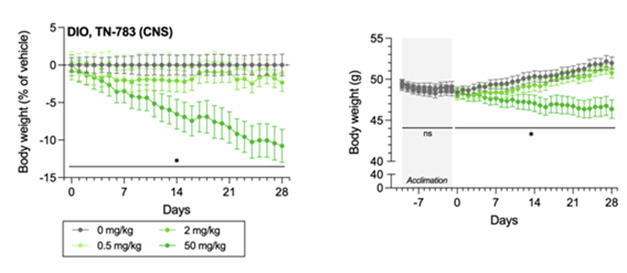
Slimming Down. Mice with diet-induced obesity (DIO) became leaner on daily 50 mg/kg doses of TN-783. Effects shown as percent of body weight lost relative to untreated mice (left) or absolute weight loss (right). [Courtesy of Guo et al., bioRxiv, 2025.]
Body weight is governed by a balance of calories consumed versus those burned. Which side of this equation was TN-783 influencing? To find out, the scientists placed the mice into Comprehensive Lab Animal Monitoring System (CLAMS) chambers for two three-day stints at the beginning and end of their month-long treatment with TN-783. These specialized cages take stock of feeding behavior, physical activity, and metabolic rate, which is inferred by the ratio of oxygen and carbon dioxide within the chamber. In a nutshell, TN-783’s weight loss effects were attributed to a drop in caloric intake, not an uptick in metabolism.
“This fits with idea that feeding is controlled by the CNS, and the weight loss effect of TN-783 is achieved by reduction in feeding, not energy expenditure,” Yulyaningsih told Alzforum.
The scientists next studied the brain’s locus of control for eating, i.e., the hypothalamus. In obese mice on a high-fat diet, they found rampant microgliosis in the arcuate nucleus. The ARC houses orexigenic and anorexigenic neurons that promote feelings of hunger and satiety, respectively. Treatment with TN-783 calmed the microglial mayhem there, bringing ARC microglia down to numbers found in their lean counterparts.
Bulk transcriptomics of the hypothalamus then identified 1,000 genes that were differentially expressed in mice on the high-fat diet, many of them figuring in cellular metabolism and inflammation. Treatment with TN-783 reversed most of these changes, reducing the number of dysregulated genes to 96. Many of these reversals reflected less inflammation, consistent with TN-783’s inhibition of the NLRP3 inflammasome, Yulyaningsih told Alzforum. Proteomics of the hypothalamus told a similar story, where TN-783 treatment reversed many of the differences in protein levels previously provoked by the high-fat diet, including proteins involved in trafficking, neurotransmission and neuronal signaling, and immune regulation.
Yulyaningsih and colleagues believe this correction of obesity-induced changes likely restores functional satiety circuits in the ARC, which explains why the obese rodents suddenly ate less. The lean mice’s appetites were unaffected by TN-783, suggesting that NLRP3 inhibition corrects pathological overactivation of the inflammasome, while leaving normal signaling intact, the authors told Alzforum.
Pete Thornton of NodThera, a company jointly based in Boston, Massachusetts, and Cambridge, U.K., commented that Tenvie’s preclinical findings with TN-783 are consistent with those of NodThera’s NT-0796, which also counteracted obesity from the brain. Thornton added that most, but not all, of NT-0796’s fat-burning effects could be attributed to reduced food intake, suggesting that NLRP3 inhibition might rewire adipose lipolysis pathways in addition to curbing food intake. “An understanding of whether TG-783 may also affect these pathways would be useful,” he wrote.
How does TN-783 compare to semaglutide? The scientists treated obese mice for 40 days with either drug alone, or both in combination. On semaglutide alone, weight plummeted rapidly before leveling off by two weeks, while TN-783 resulted in a more gradual drop in body weight that continued to the end of the treatment period. Combining the two drugs led to more overall weight loss than either drug by itself, and did so in a more sustained trajectory than did semaglutide alone (image below).

Add-On Benefit. Relative to obese mice treated with neither drug (grey), mice on both semaglutide and TN-783 (purple) lost more weight than those on semaglutide (red) or TN-783 (green) alone. [Courtesy of Guo et al., bioRxiv, 2025.]
The plateau, combined with side effects in some people, limits semaglutide’s efficacy. Could TN-783 help? The scientists found that switching obese mice from semaglutide to TN-783 after semaglutide’s effects had plateaued prompted another round of weight loss, which was maintained if mice stayed on TN-783 (image below). Stopping either drug led to a rapid rebound in food intake and weight gain.

Past the Plateau. After 28 days on semaglutide (red) or a suspension with no drug (grey), mice that switched to TN-783 (purple) lost more weight, while those still on semaglutide leveled off. Weight loss continued on TN-783 (green), and rebounded in mice once treatment stopped. [Courtesy of Guo et al., bioRxiv, 2025.]
Both drugs improved glucose tolerance, as judged by a shorter blood sugar spike in response to a glucose tolerance test. Semaglutide outperformed TN-783 in this regard, in keeping with its enhancement of insulin release from the pancreas. Yulyaningsih told Alzforum that TN-783’s glucose metabolism benefit is likely secondary to its effects on food intake and weight loss. However, it’s also possible that the drug improves glucose metabolism via peripheral mechanisms, she added, for example by relieving inflammation in white adipose tissue.
Tenvie’s CEO Anthony Estrada told Alzforum that the company is readying a lead compound for clinical trials, which he hopes to begin during the first half of 2026. Beyond obesity, Tenvie is studying NLRP3 inhibitors for Parkinson’s, Alzheimer’s, multiple sclerosis, and amyotrophic lateral sclerosis.
Tenvie’s compounds will compete with NLRP3 inhibitors already in clinical development for different indications. After NodThera’s NT-0796 posted promising Phase 1b/2a findings suggesting a reduction of body weight and systemic inflammation, a Phase 2 obesity trial is currently recruiting (press release), while a Phase 2 Parkinson’s study is in the works (Clarke et al., 2025). Meanwhile, Ventyx Biosciences is testing its CNS-penetrant NLRP3 inhibitor, VTX3232, in Phase 2 trials for the same two indications (clinical trial; clinical trial). Roche is evaluating its contender, selnoflast, for multiple disorders, including PD, while Novartis is evaluating DFV890 for knee osteoarthritis and cardiovascular disease risk reduction. Olatec’s dapansutrile is being evaluated for multiple disorders, including Parkinson’s. Finally, Ventus Therapeutics is evaluating its brain-penetrant inflammasome douser, VENT-02, in Phase 2 trials for Parkinson’s and osteoarthritis in obese people. This company recently reported that its inhibitor counteracted neuropathology and neuronal loss in a post-symptomatic AD mouse model (Auger et al., 2025).
Michael Heneka commented that besides buttressing the idea that hypothalamic inflammasome activation promotes obesity, the Tenvie study also demonstrates that NLRP3 inhibitors can successfully cross into the brain and modify functions there. “Together with preclinical data from Ventus’s brain-penetrant inhibitor, the present data further support testing of NLRP3 inflammasome inhibitors in neurodegenerative disease and in particular in Alzheimer disease,” Heneka wrote.
Alzheimer’s scientists are awaiting results from an ongoing Phase 3 trial evaluating semaglutide in early AD. Topline results are expected at the upcoming CTAD meeting in December.—Jessica Shugart
References
Therapeutics Citations
Paper Citations
- Thaler JP, Yi CX, Schur EA, Guyenet SJ, Hwang BH, Dietrich MO, Zhao X, Sarruf DA, Izgur V, Maravilla KR, Nguyen HT, Fischer JD, Matsen ME, Wisse BE, Morton GJ, Horvath TL, Baskin DG, Tschöp MH, Schwartz MW. Obesity is associated with hypothalamic injury in rodents and humans. J Clin Invest. 2012 Jan;122(1):153-62. Epub 2011 Dec 27 PubMed.
- Baufeld C, Osterloh A, Prokop S, Miller KR, Heppner FL. High-fat diet-induced brain region-specific phenotypic spectrum of CNS resident microglia. Acta Neuropathol. 2016 Sep;132(3):361-75. Epub 2016 Jul 8 PubMed.
- Valdearcos M, Douglass JD, Robblee MM, Dorfman MD, Stifler DR, Bennett ML, Gerritse I, Fasnacht R, Barres BA, Thaler JP, Koliwad SK. Microglial Inflammatory Signaling Orchestrates the Hypothalamic Immune Response to Dietary Excess and Mediates Obesity Susceptibility. Cell Metab. 2017 Jul 5;26(1):185-197.e3. PubMed.
- Stienstra R, van Diepen JA, Tack CJ, Zaki MH, van de Veerdonk FL, Perera D, Neale GA, Hooiveld GJ, Hijmans A, Vroegrijk I, van den Berg S, Romijn J, Rensen PC, Joosten LA, Netea MG, Kanneganti TD. Inflammasome is a central player in the induction of obesity and insulin resistance. Proc Natl Acad Sci U S A. 2011 Sep 13;108(37):15324-9. Epub 2011 Aug 29 PubMed.
- Vandanmagsar B, Youm YH, Ravussin A, Galgani JE, Stadler K, Mynatt RL, Ravussin E, Stephens JM, Dixit VD. The NLRP3 inflammasome instigates obesity-induced inflammation and insulin resistance. Nat Med. 2011 Feb;17(2):179-88. Epub 2011 Jan 9 PubMed.
- Thornton P, Reader V, Digby Z, Smolak P, Lindsay N, Harrison D, Clarke N, Watt AP. Reversal of High Fat Diet-Induced Obesity, Systemic Inflammation, and Astrogliosis by the NLRP3 Inflammasome Inhibitors NT-0249 and NT-0796. J Pharmacol Exp Ther. 2024 Feb 15;388(3):813-826. PubMed.
- Wen H, Gris D, Lei Y, Jha S, Zhang L, Huang MT, Brickey WJ, Ting JP. Fatty acid-induced NLRP3-ASC inflammasome activation interferes with insulin signaling. Nat Immunol. 2011 May;12(5):408-15. Epub 2011 Apr 10 PubMed.
- Melo HM, Seixas da Silva GD, Sant'Ana MR, Teixeira CV, Clarke JR, Miya Coreixas VS, de Melo BC, Fortuna JT, Forny-Germano L, Ledo JH, Oliveira MS, Figueiredo CP, Pardossi-Piquard R, Checler F, Delgado-García JM, Gruart A, Velloso LA, Balthazar ML, Cintra DE, Ferreira ST, De Felice FG. Palmitate Is Increased in the Cerebrospinal Fluid of Humans with Obesity and Induces Memory Impairment in Mice via Pro-inflammatory TNF-α. Cell Rep. 2020 Feb 18;30(7):2180-2194.e8. PubMed.
- Clarke N, Thornton P, Reader V, Lindsay N, Digby Z, Mullen B, Gorman M, Jacobson E, Langdon G, Johnstone H, Wheeler A, Watt AP. Anti-Neuroinflammatory and Anti-Inflammatory Effects of the NLRP3 Inhibitor NT-0796 in Subjects with Parkinson's Disease. Mov Disord. 2025 Oct;40(10):2199-2208. Epub 2025 Aug 12 PubMed.
- Auger A, Faidi R, Rickman AD, Martinez CP, Fajfer A, Carling J, Hilyard A, Ali M, Ono R, Cleveland C, Seliniotakis R, Truong N, Chefson A, Raymond M, Germain MA, Crackower MA, Heckmann BL. Post-symptomatic NLRP3 inhibition rescues cognitive impairment and mitigates amyloid and tau driven neurodegeneration. NPJ Dement. 2025;1(1):3. Epub 2025 May 6 PubMed.
External Citations
Further Reading
No Available Further Reading
Primary Papers
- Guo J, Bachor TP, Takahashi R, Steffek M, Fitzgerald GA, Huffman BJ, Braun D, Han SJ, Sandmann T, Ha C, Lexa KW, Hsieh Y-T, Agam MR, Sun EW, Wang X, Liu M, deVicente J, Fox BM, Campbell MK, Cavnar SP, Yuen TJ, Fischer TZ, Estrada AA, Craig RA, Yulyaningsih E. CNS-penetrant NLRP3 inhibitor achieves durable weight loss and reverses hypothalamic inflammation in diet-induced obesity. 2025 Oct 09 10.1101/2025.10.06.680810 (version 1) bioRxiv.
Annotate
To make an annotation you must Login or Register.
Comments
University of Toronto
This elegant and thought-provoking study strengthens the idea that selective targeting of the NLRP3 inflammasome—particularly in the hypothalamus—could represent a new way to tackle obesity. TN-783’s central action appears to restore microglial balance and sustain fat-specific weight loss, even extending the benefits of semaglutide
While GLP-1 receptor agonists have well-recognized anti-inflammatory effects, inflammasome inhibition provides a mechanistically distinct and potentially complementary strategy. That said, careful clinical translation will be critical—especially to define CNS safety, durability, and tolerability before broader application, including possible roles in neurodegenerative diseases such as Alzheimer’s and Parkinson’s.
NodThera
Tenvie provide an excellent verification of NodThera's data (Thornton et al., 2024), confirming that NLRP3 inhibition achieves weight loss in diet-induced obesity models. Furthermore, Tenvie's data on its brain penetrant molecule, TG-783, supports our original finding that CNS NLRP3 inhibition is required for efficacy in this model.
We do note that the degree of weight loss with NodThera's NT-0796 was superior to TG-783 (>15 percent v <15 percent at 28 days of dosing), an effect potentially driven by the superior brain penetration of NT-0796 relative to TG-783. Also in agreement with our data, the weight loss effect of NLRP3 inhibition (with TG-783) appears to be largely mediated via a reduction in calorie intake. However, even when correcting for calorie intake (with weight-matched control mice) we reported that NLRP3 inhibition with NT-0796 delivers additional loss in white adipose tissue mass. This indicates that a rewiring of adipose lipolysis pathways can be achieved via CNS NLRP3 inhibition, and an understanding of whether TG-783 may also affect these pathways would be useful.
It would also be intriguing to understand how TG-783 is regulating circulating and liver-associated markers of cardiometabolic inflammation (e.g. Fibrinogen, PCSK9, IL-1alpha), which are readily detectable in this model, and significantly reduced by NLRP3 inhibition with NT-0796 (Thornton et al., 2025).
References:
Thornton P, Reader V, Digby Z, Smolak P, Lindsay N, Harrison D, Clarke N, Watt AP. Reversal of High Fat Diet-Induced Obesity, Systemic Inflammation, and Astrogliosis by the NLRP3 Inflammasome Inhibitors NT-0249 and NT-0796. J Pharmacol Exp Ther. 2024 Feb 15;388(3):813-826. PubMed.
Thornton P, Reader V, Digby Z, Doedens J, Lindsay N, Clarke N, Watt AP. The NLRP3 inhibitor NT-0796 enhances and sustains GLP-1R agonist-mediated weight loss in a murine diet-induced obesity model. Obesity (Silver Spring). 2025 Jul;33(7):1309-1321. Epub 2025 Apr 30 PubMed.
Klinik und Poliklinik für Neurologie
There are a couple of important take aways from this paper: Beyond the fact that NLRP3 inflammasome activation seems to be implicated in obesity, strengthening the hypothesis that central, hypothalamic events are causally linked to obesity, it also highlights that NLRP3 inflammasome inhibitors can be successfully pass the blood brain barrier and modify brain cell functions. Importantly, the papers shows that the centrally acting NLRP3 inhibitor, TN-783, reduces microgliosis and transcriptional changes in response to diet-induced obesity. Collectively, these actions contribute to weight loss in the animals.
Centrally, but not peripherally, active NLRP3 inhibitors may therefore be able to provide beneficial effects previously observed in NLRP3 inflammasome knockout models (Heneka et al., 2013; Ising et al., 2019; Ravichandran and Heneka, 2024; McManus et al., 2025). Together with data, using the brain-penetrant small molecule NLRP3 inhibitor VEN-02XX (Augur et al., 2025), that show positive effects on neuroinflammation and behavior, this present study further supports the testing of NLRP3 inflammasome inhibitors in neurodegenerative disease and in particular in Alzheimer's disease.
References:
Heneka MT, Kummer MP, Stutz A, Delekate A, Schwartz S, Vieira-Saecker A, Griep A, Axt D, Remus A, Tzeng TC, Gelpi E, Halle A, Korte M, Latz E, Golenbock DT. NLRP3 is activated in Alzheimer's disease and contributes to pathology in APP/PS1 mice. Nature. 2013 Jan 31;493(7434):674-8. Epub 2012 Dec 19 PubMed.
Ising C, Venegas C, Zhang S, Scheiblich H, Schmidt SV, Vieira-Saecker A, Schwartz S, Albasset S, McManus RM, Tejera D, Griep A, Santarelli F, Brosseron F, Opitz S, Stunden J, Merten M, Kayed R, Golenbock DT, Blum D, Latz E, Buée L, Heneka MT. NLRP3 inflammasome activation drives tau pathology. Nature. 2019 Nov;575(7784):669-673. Epub 2019 Nov 20 PubMed.
Ravichandran KA, Heneka MT. Inflammasomes in neurological disorders - mechanisms and therapeutic potential. Nat Rev Neurol. 2024 Feb;20(2):67-83. Epub 2024 Jan 9 PubMed.
McManus RM, Komes MP, Griep A, Santarelli F, Schwartz S, Ramón Perea J, Schlachetzki JC, Bouvier DS, Khalil MA, Lauterbach MA, Heinemann L, Schlüter T, Pour MS, Lovotti M, Stahl R, Duthie F, Rodríguez-Alcázar JF, Schmidt SV, Spitzer J, Noori P, Maillo A, Boettcher A, Herron B, McConville J, Gomez-Cabrero D, Tegnér J, Glass CK, Hiller K, Latz E, Heneka MT. NLRP3-mediated glutaminolysis controls microglial phagocytosis to promote Alzheimer's disease progression. Immunity. 2025 Feb 11;58(2):326-343.e11. Epub 2025 Feb 3 PubMed.
Auger A, Faidi R, Rickman AD, Martinez CP, Fajfer A, Carling J, Hilyard A, Ali M, Ono R, Cleveland C, Seliniotakis R, Truong N, Chefson A, Raymond M, Germain MA, Crackower MA, Heckmann BL. Post-symptomatic NLRP3 inhibition rescues cognitive impairment and mitigates amyloid and tau driven neurodegeneration. NPJ Dement. 2025;1(1):3. Epub 2025 May 6 PubMed.
Make a Comment
To make a comment you must login or register.