
No Bull—Taurine Not a Marker of Aging, After All
Quick Links
Two years ago, scientists led by Vijay Yadav, then at Columbia University, outlined evidence that serum levels of the semi-essential amino acid taurine decline with age and that adding it as a supplement prevented inflammation and increased lifespan in mice and primates. The data made a splash worldwide (Jun 2023 news). Now, scientists led by Rafael de Cabo at the NIA, Baltimore, call those findings into doubt. Both papers appeared in Science magazine, de Cabo’s on June 5.
- Prior data hinted that taurine levels decrease with age.
- Now, longitudinal data show taurine remains stable, or even increases.
- The nonessential amino acid is no marker of aging.
Their longitudinal and cross-sectional analyses of taurine concentrations in healthy people from distinct geographically areas, as well as in mice and monkeys of both sexes over a comprehensive age range, suggest no tapering of taurine during life. If anything, it might increase slightly. Why the discrepancy? Intra-individual taurine levels vary so much that it can be difficult to tease out age-related trends, de Cabo and colleagues say.
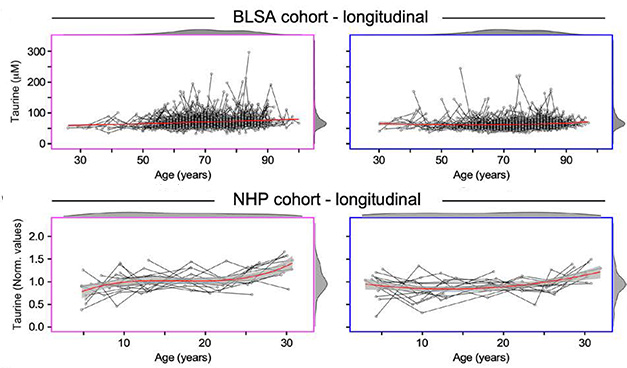
Invariably Variable. In both people (top) and nonhuman primates (bottom) taurine levels varied greatly between individuals but changed little with age. [Courtesy of Fernandez et al., Science, 2025.]
First author Maria Emilia Fernandez and colleagues analyzed plasma data from three longitudinal studies—the Baltimore Longitudinal Study of Aging in the U.S., the Balearic Islands Study of Aging in Spain, and the Predictive Medicine Research study (PREMED) run at Emory University, Atlanta. For good measure, they threw in analysis from the sera of nonhuman primates and mice. The scientists found that taurine levels varied within individuals throughout their lives and between individuals of the same age, greatly diminishing its utility as a biomarker of aging (image above).
Interestingly, across the board, women had more taurine in their plasma than did men, and their levels ticked up more erratically throughout life (image below). Indeed, the Emory study found no change in plasma taurine among men as they aged. Likewise, the Study of Longitudinal Aging in Mice found male taurine levels stayed constant. The data highlight male/female, geographical, and even species differences in taurine biology and question its value as biomarker.

Common Trends. Circulating taurine levels largely increase with age in humans, primates, and mice. [Courtesy of Fernandez et al., Science, 2025.]
What about correlations with health? The authors note taurine changes with diet, which could explain the variability of baseline taurine levels in past studies. Here, the authors controlled for diet and medical history, finding no link between plasma taurine and body weight or muscle strength. Yadav confirmed that these phenotypic findings are consistent with their data from the EPIC-Norfolk cohort.
De Cabo thinks the real value lies in studying the physiological response to taurine, perhaps as a supplement. In a press briefing held by Science, Yadav, now at Rutgers New Jersey Medical School, Newark, stood by his data on taurine supplementation being beneficial and that deficiency decreased lifespan in animal models. In people, he found that plasma taurine plummeted between birth and age 30—a range de Cabo’s and colleagues did not study—suggesting inadequate taurine might accelerate aging. He is now testing the amino acid in a clinical trial. “This trial, we hope, will generate sufficiently rigorous data to show whether taurine supplementation delays the pace of aging in humans [or] increases health and fitness,” he said. He and de Cabo agreed that clinical trials are necessary before recommending taurine supplementation, and they called for more research.
“The discrepancy needs to be analyzed more in depth,” suggested Luigi Ferrucci, NIA, co-author of the new paper. “It may reveal some important mechanism of aging that could be a target for intervention.” — Sara A.M. Holec
Sara A.M. Holec is a scientist in Fort Collins, Colorado.
References
News Citations
Further Reading
Papers
- Singh P, Gollapalli K, Mangiola S, Schranner D, Yusuf MA, Chamoli M, Shi SL, Lopes Bastos B, Nair T, Riermeier A, Vayndorf EM, Wu JZ, Nilakhe A, Nguyen CQ, Muir M, Kiflezghi MG, Foulger A, Junker A, Devine J, Sharan K, Chinta SJ, Rajput S, Rane A, Baumert P, Schönfelder M, Iavarone F, di Lorenzo G, Kumari S, Gupta A, Sarkar R, Khyriem C, Chawla AS, Sharma A, Sarper N, Chattopadhyay N, Biswal BK, Settembre C, Nagarajan P, Targoff KL, Picard M, Gupta S, Velagapudi V, Papenfuss AT, Kaya A, Ferreira MG, Kennedy BK, Andersen JK, Lithgow GJ, Ali AM, Mukhopadhyay A, Palotie A, Kastenmüller G, Kaeberlein M, Wackerhage H, Pal B, Yadav VK. Taurine deficiency as a driver of aging. Science. 2023 Jun 9;380(6649):eabn9257. PubMed.
Primary Papers
- Fernandez ME, Bernier M, Price NL, Camandola S, Aon MA, Vaughan K, Mattison JA, Preston JD, Jones DP, Tanaka T, Tian Q, González-Freire M, Ferrucci L, de Cabo R. Is taurine an aging biomarker?. Science. 2025 Jun 5;388(6751):eadl2116. Epub 2025 Jun 5 PubMed.
Annotate
To make an annotation you must Login or Register.
Comments
No Available Comments
Make a Comment
To make a comment you must login or register.