
Next Up—Combination Trials for Sporadic Alzheimer’s
Quick Links
Now that doctors are prescribing anti-amyloid therapies for Alzheimer’s disease, scientists have begun to focus their energy on the other pathological hallmark of AD, neurofibrillary tangles. While trialists used to go after tau alone, they now think combining anti-tau and anti-amyloid therapies is the most ethical strategy. At the Tau Global Conference, held April 24-25 in London, two such trials were on the agenda. One, a platform trial, might begin late this year. Another, by Eisai Inc., is up and running.
- Long-awaited platform trial for sporadic AD to start this year.
- Two anti-tau therapies will be tested alone or with an anti-Aβ treatment.
- Eisai trial using E2814 and lecanemab concurrently has begun.
Adam Boxer, University of California, San Francisco, gave an update on the Alzheimer’s Tau Platform trial, an idea that has been in planning since 2021. Now funded by the NIH to the tune of $20 million and supported with infrastructure and resources by the Alzheimer’s Clinical Trials Consortium, it seems APT is finally getting traction. What drugs are to be tested is still a mystery, though.
ATP plans to combine anti-amyloid and anti-tau treatment in preclinical or very early AD. It targets people who have begun to amass amyloid plaques, have no or only mild symptoms, and whose tangles have not spread beyond the medial temporal lobe—a sign their brain is not yet embroiled in the “ca-tau-strophe.” ATP’s design has evolved over the years (Nov 2021 conference news).
The trial will now use plasma p-tau217 to prescreen. The idea is to capture those who have mild tangle accumulation in the temporal gyrus, i.e., a regional SUVR of 1.25 or more on a PET scan using the ligand MK6240. Boxer didn’t say what plasma p-tau217 cutoff would yield such participants. They must have a global CDR score of 0 or 0.5, and a CDR-sb below 1.5—in other words be at most mildly impaired. The trial will accept people between 50 and 80, but participants without symptoms needs to be older than 60.
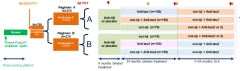
ATP Design. After a six-month run-in on placebo or anti-amyloid therapy, participants will take one of two still-undisclosed tau drugs for two years, either alone or in combination with the amyloid drug. During a two-year open-label extension, everyone will receive one of the two anti-tau treatments. [Courtesy of Adam Boxer, UCSF.]
Seven hundred and fifty people will be randomized into two equal groups. In each, 150 will receive placebo and 225 an anti-amyloid drug for six months (image above). For the next two years, people on placebo will switch to an anti-tau treatment, 75 people will continue on anti-amyloid alone, and 150 people on anti-amyloid treatment will also get the tau therapy. At trial’s end, 300 people will have received one of two tau treatments alone, 300 will get anti-amyloid plus one of the two tau treatments, and 150 will have just had an anti-amyloid therapy. An open-label extension will run for up to two years. Boxer again declined to say what the drugs are. He told Alzforum he hopes to do so this summer, and that the trial is scheduled to begin later this year. Approximately 75 sites in the U.S. will be involved.
Change in tau PET using MK6240 will be the primary endpoint; others being amyloid PET, changes in plasma p-tau217, GFAP, NfL, and eMTBR-tau243. The PACC5, CDR-sb, and ADCS activities of daily living will measure clinical changes.
Boxer sees this as a master protocol with possibilities for the trial to run perpetually and add new therapies. People at the London conference asked if those could target soluble tau, or the aggregation process, rather than tangles. Boxer considers aggregation inhibitors a nonstarter. “We don’t have much experience with that approach bar for methylene blue, and the mechanism there is unclear,” said Boxer. Other drugs designed to prevent tau aggregation, such as ceperognastat and BIIB113 have fallen short in trials. Boxer speculated that it would be exciting to test antibodies that bind tau oligomers, such as those recently made by Thomas Karikari at University of Pittsburgh, and Kaj Blennow at the University of Gothenburg, Sweden (Feb 2025 news).
For its part, Eisai says it is going after tau seeds with the anti-tau antibody E2814. “The proposed mechanism is it binds to seed competent species, accelerates their clearance, and slows or stops tau accumulation or spread,” Larisa Reyderman, Eisai, Nutley, New Jersey, said in London. E2814 binds the R2 and R4 repeats in tau’s microtubule binding region, which is a bit more N-terminal than the experimental biomarker antibodies Blennow and Karikari described, and is at the core of tau fibrils. Eisai believes these core sequences drive tau propagation, and Reyderman said theirs is the most advanced antibody program targeting MTBR (Mar 2021 news).
In people with autosomal-dominant AD, E2814 reduced CSF MTBR-tau243, and subsequently the DIAN trials unit started evaluating E2814 concurrently with lecanemab in the NexGen trial, which is fully enrolled (Aug 2024 news). Scientists believe MTBR-tau243 is a marker of tangles (Apr 2025 conference news).
In London, Reyderman fleshed out details of the next concurrent trial, in sporadic AD, a first for this drug. Her talk mostly overlapped with what Eisai’s Thomas Doherty had said at AD/PD a few weeks before (May 2025 conference news). Read on for the gist and some additional details.
This 18-month trial, 202, began last September. Its 90 participants will be divided into five groups, receiving 500 mg of weekly subcutaneous lecanemab alone, or with monthly infusions of 500 mg, 750 mg, 1500 mg, or 3000 mg of E2814 (image below).

Alzheimer’s Twofer. Eisai’s 202 trial evaluates E2814 concurrently with lecanemab in early stage AD. [Courtesy of Eisai Inc.]
A plasma p-tau217-based algorithm selects participants who have sufficient amyloid in their brain to trigger tau propagation. Dose response on CSF MTBR-tau243 is the primary endpoint; secondaries are tau PET, CSF p-tau217, safety, and tolerability. A secondary endpoint—change in CSF MTBR-tau243 at six months—will be used to assess dose selection for an upcoming Phase 3 trial of E2814 with lecanemab, Reyderman told Alzforum. No details on that yet.
Attendees were delighted by this approach. HIV and cancer treatments have for decades been using combination therapy, and neurology is finally moving in this direction. One attendee asked if using two antibodies might overtax microglia. Reyderman said she didn’t anticipate the two to be additive in that respect.
Annabel Smith, U.K. Dementia Research Institute, Cambridge, wanted to know how targeting seeds might affect tangles already in the brain. “Would you expect the tau PET signal to be stable with this treatment?” she asked. Reyderman thought this was a great question. “One hypothesis is that by eliminating seeds and stopping the brain from making more aggregates, it can clear what is already there, so the PET signal may come down,” she said.
Closing with a little humor, one Tolkien fan asked whether, rather than tackling different targets with different tools, one therapy could be found that could “rule them all.” Reyderman thinks it unlikely. “If we could demonstrate that all the targets we discussed at this meeting are not causal, but are downstream, then the answer would be yes,” she said. Felix Yeh, Genentech, South San Francisco, ventured that boosting proteostasis might fit the bill. “I suspect all these pathologies reflect deficits of proteostasis, so hypothetically, one potential panacea is boosting clearance,” he said.
For Reyderman, combining therapies for now seems the way to go. “Conceptually, combination treatment would cover all the bases,” she said.—Tom Fagan
References
News Citations
- More Tau Antibodies Bid Adieu; Semorinemab Keeps Foot in Door
- New Biomarkers Catch Tau Before It Tangles
- Aiming at the Tangle’s Heart? DIAN-TU Trial to Torpedo Tau’s Core
- First Success Stories From Alzheimer’s Secondary Prevention Trial
- Will We Soon Stage Alzheimer’s With Plasma Markers?
- Next Act for Amyloid Immunotherapy: Be Safer, Target Tau, Too
Therapeutics Citations
External Citations
Further Reading
Annotate
To make an annotation you must Login or Register.
Comments
No Available Comments
Make a Comment
To make a comment you must login or register.