
Blood Contains Different Markers for Cognition and for Neuropathology
Quick Links
Scientists know that most people with Alzheimer’s disease also have other pathologies in the brain. They don’t know how much the latter contributes to cognitive problems. In the September 10 Nature Aging, scientists led by Erik Johnson at Emory University School of Medicine, Atlanta, reported that other common pathologic changes each harm cognition as much as do plaques and tangles. Even so, all of them together still fall far short of explaining the full scope of a person’s decline.
- Large proteomics analysis tied 496 plasma proteins to cognition.
- Only 255 of those were linked to any common neuropathology.
- Cognitive decline also correlated with changes in synaptic, immune, and proteostasis proteins.
In a plasma proteomic analysis of four AD cohorts comprising more than 2,000 people, only half the proteins linked to cognitive decline were associated with plaques, tangles, Lewy bodies, TDP-43 deposits, cerebral amyloid angiopathy, or vascular issues. The other half pointed to synapses, proteostasis, and immune function, suggesting these biological processes may be equally central to faltering cognition.
Eugeen Vanmechelen at ADx Neurosciences, Gent-Zwijnaarde, Belgium, was unsurprised that neuropathology markers dovetailed poorly with cognition, given that synapse loss most tightly links to decline. “It will require many more studies, especially those in which plasma is collected longitudinally, to support mechanistic links of plasma biomarker changes to cognitive decline,” he wrote to Alzforum.

Different Sets. In a meta-analysis of four AD cohorts, only 42 (gray) of the plasma proteins that associated with amyloidosis (purple) also associated with cognitive status (green). [Courtesy of Afshar et al., 2025, Nature Aging.]
How common are co-pathologies? A previous study found that 90 percent of people who died around age 90 had more than one pathology in the brain (Nichols et al., 2023). Other scientists have reported that the more neuropathologies a person accumulates, the more likely they are to have cognitive problems (Schneider et al., 2007).
Joint first authors Shiva Afshar and Eric Dammer set out to quantify the contribution of each pathology. They used blood, which is more readily available than cerebrospinal fluid, analyzing samples from 989 participants in the Bio-Hermes biomarker study, 436 in the Religious Orders Study and Rush Memory and Aging Project, 493 people seen at the Emory Alzheimer’s Disease Research Center, and 221 from additional studies at Emory. Altogether, the 2,139 participants were 74 years old on average, and 42 percent were amyloid-positive. Slightly more than half of the cohort were cognitively healthy controls, with the rest diagnosed with either asymptomatic AD, mild cognitive impairment, or AD dementia. The authors generated plasma proteomic data using the SomaScan 7K array measuring 6,345 proteins.
A meta-analysis of the four cohorts linked 214 proteins to amyloidosis in the brain. Many of these proteins are involved in cellular metabolism, proteostasis, extracellular matrix, and synaptic function. About three-quarters of amyloidosis-related protein alterations were associated with the APOE4 genotype, singling this out as the major mechanism. Overall, the findings agreed well with a previous proteomic study of serum from late-onset AD patients in Iceland, the authors noted (Sep 2024 news).
Notably, though, these amyloidosis-related proteins had little bearing on cognitive decline. In a separate meta-analysis, the authors identified 283 plasma proteins linked to cognitive status. Only 15 percent of them overlapped with the amyloidosis set (image above).
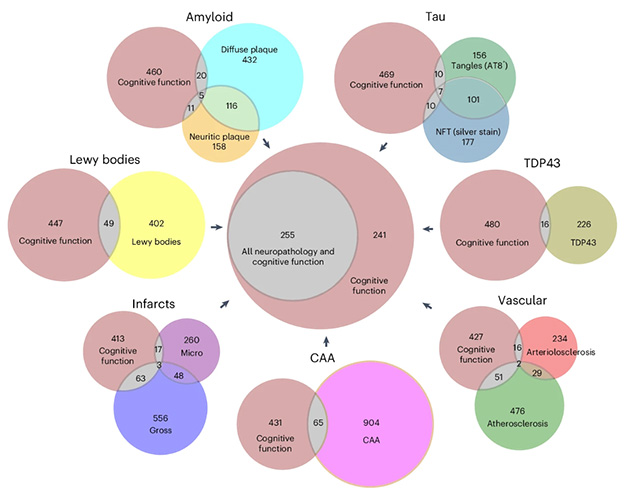
Pathology Doesn’t Cover It. In a ROSMAP cohort, each of the assessed neuropathologies overlapped (gray) with a small fraction of the plasma proteins linked to cognitive decline (puce color). Altogether, almost half the cognition-associated protein changes remained unexplained (center circles). [Courtesy of Afshar et al., 2025, Nature Aging.]
Do pathologies other than plaques better explain decline? The authors probed the ROSMAP dataset for answers. In this cohort, all participants had died and been autopsied. Here, amyloidosis explained only 7 percent of the 496 proteins linked to cognitive decline. Similarly, tangles, Lewy bodies, TDP-43 deposits, and CAA each explained from 3 to 13 percent. Vascular pathologies such as arteriolosclerosis, atherosclerosis, and infarcts had a larger impact, together accounting for 30 percent of decline-related proteins.
All told, and given some overlap, these pathologies accounted for about half the proteins associated with cognitive decline (image above). What explains the other half? Perhaps brain pathologies not measured in this study are to blame. Or brain pathologies are involved that are yet to be identified. Or maybe peripheral biology influences memory?
Some clues came from analysis of cellular biology pathways. Cognitive decline in general, regardless of pathology, was most strongly linked to protein synthesis, clearance, and degradation, emphasizing this as a key process. Synaptic proteins also played a starring role, with the neuronal pentraxin receptor NPTXR popping up in all four cohorts such that higher plasma levels correlated with better brain function. Other studies have linked low neuronal pentraxin 2 to AD, but this marker did not show up in plasma (Aug 2019 conference news; Apr 2025 news; May 2025 news). Conversely, high amounts of immune proteins in plasma were associated with worse cognition, regardless of the person’s amyloid status. Meanwhile, extracellular matrix proteins correlated with cognitive decline were also linked to vascular pathologies and CAA, hinting they might act via effects on blood vessels.
One caveat to this study? Changes in some of these blood proteins had little relationship to what was happening to their counterparts in the brain. When the authors compared the amyloidosis-linked plasma protein set to their previous study of plaque-associated proteins in brain tissue, only 4 percent overlapped (Feb 2022 news). Moreover, while some plasma and brain changes were concordant, extracellular matrix components being a strong example, ROSMAP data showed that many proteins changed in opposite directions. For example, many synaptic proteins went down in brain, but up in plasma, during cognitive decline.—Madolyn Bowman Rogers
References
News Citations
- Among Icelanders, Blood Proteome Predicts Dementia, Parses Role of ApoE4
- Synaptic Proteins in CSF: New Markers of Cognitive Decline?
- Do Synaptic Markers Foreshadow Cognitive Decline?
- Does Loss of Neuronal Pentraxin 2 Start Network Dysfunction in Alzheimer’s?
- Proteomics Highlight Alzheimer’s Changes in Matrisome, MAPK Signaling
Paper Citations
- Nichols E, Merrick R, Hay SI, Himali D, Himali JJ, Hunter S, Keage HA, Latimer CS, Scott MR, Steinmetz JD, Walker JM, Wharton SB, Wiedner CD, Crane PK, Keene CD, Launer LJ, Matthews FE, Schneider J, Seshadri S, White L, Brayne C, Vos T. The prevalence, correlation, and co-occurrence of neuropathology in old age: harmonisation of 12 measures across six community-based autopsy studies of dementia. Lancet Healthy Longev. 2023 Mar;4(3):e115-e125. PubMed.
- Schneider JA, Arvanitakis Z, Bang W, Bennett DA. Mixed brain pathologies account for most dementia cases in community-dwelling older persons. Neurology. 2007 Dec 11;69(24):2197-204. PubMed.
Further Reading
News
- On the Hunt for Fluid Biomarkers of Cerebral Amyloid Angiopathy
- Big Data Insights: Blood Signatures of Cognitive Decline, Aging, APOE4
- GNPC: Mining 40,000 Fluid Samples for Neurodegeneration Markers
- Do Synaptic Markers Foreshadow Cognitive Decline?
- Is Your Brain Aging Fast? Plasma Proteins Might Tell
- Some Plasma Proteins Bolster Phagocytosis and Metabolism in Microglia
- CSF Proteomics Hints at How ApoE4 Promotes AD, and How a Drug Hinders It
- Large Proteomic Study Flags Blood Biomarkers That Could Foretell Dementia
Primary Papers
- Afshar S, Dammer EB, Bian S, Bennett DA, Mohs R, Beauregard D, Dwyer J, Hales CM, Goldstein FC, Parker MW, Trammell AR, Watson CM, Golde TE, Seyfried NT, Roberts BR, Manzanares CM, Lah JJ, Levey AI, Johnson EC. Plasma proteomic associations with Alzheimer's disease endophenotypes. Nat Aging. 2025 Oct;5(10):2104-2124. Epub 2025 Sep 10 PubMed.
Annotate
To make an annotation you must Login or Register.
Comments
Amsterdam UMC, loc. VUmc
What a tremendous gift this paper is for our research community! Now that tools such as SomaLogic and proximity extension assay-based platforms make it relatively easy to measure many proteins at the same time in large samples of plasma, many papers and initiatives are starting to come out. Still, many of these studies so far lacked biomarker- or postmortem-confirmed evidence of Alzheimer’s disease pathology. That is achieved here. What’s more, we now get to see how other co-pathologies that may further contribute to plasma protein levels as measured with SomaLogic, and finally also a direct comparison of plasma protein levels with tissue protein levels. This provides much-needed insights into how plasma proteins may be related to underlying pathological mechanisms in the brain.
The paper also investigated proteins that are related to cognitive decline, which is one of the most important yet unresolved issues in AD. Individuals with abnormal amyloid markers and without dementia vary greatly in their rates of decline, and amyloid, tau, as well as APOE genotype explain only part of this variance (Jutten et al., 2021). This suggests that there must be other mechanisms that are kicked off by pathology that underlie cognitive decline.
Also, it is likely that heterogeneity in underlying diseases processes may further contribute to this decline. We found, for example, that protein levels in CSF related to decline in MCI with abnormal amyloid depended on CSF tau status (Vromen et al., 2025). It would be of interest to study, in this rich data set, if similar effects also occur in plasma proteins.
Still, NPTXR, popped up as one of the most robust proteins related to cognitive decline in this work, as well as in previous studies of both CSF and plasma (e.g., Vromen et al., 2025; Oh et al., 2025). Possibly this marker may have use as a proxy outcome marker for decline, but studies using repeated CSF as well as cognitive testing are needed to further verify this potential.
One result I found surprising was that lower levels of NFL in plasma correlated with amyloid pathology. Previous studies have indicated that higher levels of ELISA-measured NFL in plasma are strongly related to higher levels of the same NFL measures in CSF (e.g., Alagaratnam et al., 2021). It is puzzling to me why this is different for the SomaLogic-based NFL. I also was surprised that this association disappeared when correcting for APOE genotype, since NFL has been reported to be elevated in many other brain diseases (e.g., Bridel et al., 2019) which do not necessarily seem to be APOE-related.
References:
Jutten RJ, Sikkes SA, Van der Flier WM, Scheltens P, Visser PJ, Tijms BM, Alzheimer's Disease Neuroimaging Initiative. Finding Treatment Effects in Alzheimer Trials in the Face of Disease Progression Heterogeneity. Neurology. 2021 Jun 1;96(22):e2673-e2684. PubMed.
Vromen EM, de Leeuw DM, van Harten AC, Teunissen CE, van der Flier WM, Visser PJ, Tijms BM. CSF proteomic profiles related to cognitive decline in MCI A+ depend on tau levels. Brain. 2025 Jul 8; Epub 2025 Jul 8 PubMed.
Oh HS, Le Guen Y, Rappoport N, Urey DY, Farinas A, Rutledge J, Channappa D, Wagner AD, Mormino E, Brunet A, Greicius MD, Wyss-Coray T. Plasma proteomics links brain and immune system aging with healthspan and longevity. Nat Med. 2025 Jul 9; Epub 2025 Jul 9 PubMed.
Alagaratnam J, von Widekind S, De Francesco D, Underwood J, Edison P, Winston A, Zetterberg H, Fidler S. Correlation between CSF and blood neurofilament light chain protein: a systematic review and meta-analysis. BMJ Neurol Open. 2021;3(1):e000143. Epub 2021 Jun 16 PubMed.
Bridel C, van Wieringen WN, Zetterberg H, Tijms BM, Teunissen CE, and the NFL Group, Alvarez-Cermeño JC, Andreasson U, Axelsson M, Bäckström DC, Bartos A, Bjerke M, Blennow K, Boxer A, Brundin L, Burman J, Christensen T, Fialová L, Forsgren L, Frederiksen JL, Gisslén M, Gray E, Gunnarsson M, Hall S, Hansson O, Herbert MK, Jakobsson J, Jessen-Krut J, Janelidze S, Johannsson G, Jonsson M, Kappos L, Khademi M, Khalil M, Kuhle J, Landén M, Leinonen V, Logroscino G, Lu CH, Lycke J, Magdalinou NK, Malaspina A, Mattsson N, Meeter LH, Mehta SR, Modvig S, Olsson T, Paterson RW, Pérez-Santiago J, Piehl F, Pijnenburg YA, Pyykkö OT, Ragnarsson O, Rojas JC, Romme Christensen J, Sandberg L, Scherling CS, Schott JM, Sellebjerg FT, Simone IL, Skillbäck T, Stilund M, Sundström P, Svenningsson A, Tortelli R, Tortorella C, Trentini A, Troiano M, Turner MR, van Swieten JC, Vågberg M, Verbeek MM, Villar LM, Visser PJ, Wallin A, Weiss A, Wikkelsø C, Wild EJ. Diagnostic Value of Cerebrospinal Fluid Neurofilament Light Protein in Neurology: A Systematic Review and Meta-analysis. JAMA Neurol. 2019 Jun 17; PubMed.
Make a Comment
To make a comment you must login or register.