
You, Too, BCG? Tuberculosis Jab Said to Ward Off Alzheimer’s
Quick Links
At the turn of the 20th century, bovine tuberculosis, a bacterial disease that infected cows and spilled over to humans via milk ran rampant in France. Today, a weakened form of that same bacterium—Bacillus Calmette-Guérin—is the star of a Phase 2 trial whose five-year results hint it might help prevent Alzheimer’s disease. Diabetes researcher Denise Faustman, Massachusetts General Hospital, presented the results at the 2025 Clinical Trials in Alzheimer’s Disease conference, held December 1-4 in San Diego.
- The BCG vaccine activates the immune system, prompting off-label applications.
- In cognitively healthy people, it induced protein and biomarker changes that reflect AD resistance.
- AD prevention trial is in planning, seeking funding.
“Our data showed at least 14 central nervous system proteins being reset, suggesting this is changing protein processing in the brain—potentially clearing amyloid and improving brain health,” Faustman told Alzforum.
The idea of using vaccines to train the immune system against “inflammaging” —low-grade systemic inflammation associated with aging—is gaining traction in AD research (Jul 2020 conference news; Bukhbinder et al., 2023).
“This is exciting research on the potential of immunomodulatory effects of vaccines for dementia prevention, and possibly maintenance of neuroimmune health in older age more generally,” Pascal Geldsetzer, Stanford University, wrote to Alzforum. At CTAD, Geldsetzer himself presented new data suggesting that the shingles vaccine helps stave off dementia (Part 2 of this series).
The pathogen featured in Faustman’s talk was named after Albert Calmette and Camille Guérin, two scientists at the Pasteur Institute in Paris. They cultured it for more than a decade, attenuating it to create a strain that could be incorporated into a TB vaccine in 1924 (Hawgood, 2007). Like other such vaccines, BCG is too feeble to cause the disease but still trains the immune system to mount a protective response upon later exposure.
“It is the only immunotherapy against TB and has been given safely to billions of people around the world … It is not used for this purpose in the U.S. because TB is controlled by public health measures,” Pierre Tariot, Banner Alzheimer’s Institute, Phoenix, wrote to Alzforum (comment below).
Because BCG was shown to induce broad, durable immune activation, it was repurposed in the 1970s as a successful immunotherapy for bladder cancer (Chen et al., 2023; Dow and Kidess, 2022; Koeken, 2021; Morales et al., 1976). This later inspired trials in autoimmune diseases such as Type 1 diabetes (T1D).
A trial for BCG use in T1D is what brought Faustman onto the AD scene. Her group had previously found that, in mouse models and people with T1D, there was a defect in tumor necrosis factor (TNF)-mediated killing of autoreactive T cells that attack pancreatic beta cells (Ban et al., 2008). Building upon their previous proof-of-concept T1D study in six people (Faustman et al., 2012), the scientists initiated a larger randomized clinical trial testing six doses of the vaccine in 95 people with T1D. For the primary analysis, they are measuring blood sugar levels across 10 years.
Notably, studies in Israel and the U.S. that used high BCG doses for bladder cancer observed a large drop in subsequent AD incidence over average follow-up periods of three to eight years (Gofrit et al., 2019; Han et al., 2023).
“High-dose BCG given for this cancer has very nicely shown protection from Alzheimer’s,” Faustman told Alzforum. This inspired her to add secondary analyses to her T1D trial that focus on AD pathology—namely, mass spectrometry of blood samples collected annually to profile changes in AD-linked proteins and biomarkers.
By the trial’s midpoint at year five, 14 proteins of interest showed changes from baseline. BCG altered several amyloid-related proteins, including MMP9, SERPINE1, TTR, APOE, APC, and CatL. Other affected proteins were associated with neurodegeneration (YWHAG, JUP), microglial activation (GPNMB), synaptic plasticity (α-actinin 4), and membrane trafficking (GDI1, LAMP1, LAMP2, HSPB1).
The team complemented these mass spec measurements by looking for AD biomarker changes. They reported a drop in phospho-tau 217 levels, which track with brain amyloid burden, as well as alterations in the Aβ42-to-Aβ40 ratio (image below).
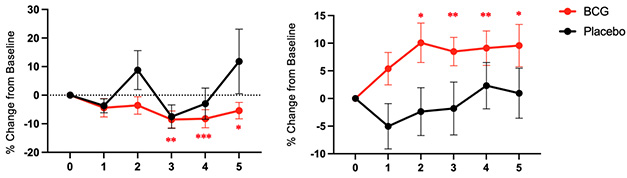
Thanks, BCG. Over five years, people who received the BCG vaccine (red) had changes relative to baseline in AD biomarker levels, namely phospho-tau217 (left) and Aβ42/Aβ40 (right), that reflect a healthier brain compared to the unvaccinated group (black). [Courtesy of Faustman, 2025, CTAD.]
How might this work? Beyond TNF signaling and T cell activation, BCG reshapes glucose metabolism and protein trafficking, Faustman explained to Alzforum (Kühtreiber et al., 2018; Lee et al., 2010). She suspects the vaccine’s effects on glucose processing may lie at the intersection of its protection against both T1D and AD. “BCG flips systemic metabolism to aerobic glycolysis, allowing cells to produce ATP faster and potentially rescuing neurons before they die,” Faustman said. No adverse effects have been observed in this trial, she added.
“One question is how far can we push this prevention? Would 70 be too late?” she told Alzforum. Working with Steven Arnold, Marc Weinberg, and others at MGH, Faustman at CTAD also showed results from a one-year open-label study in 23 adults aged 55 or older, some with AD and some without. Two BCG doses reset the expression of participants’ immune and metabolism genes in CNS and blood immune cells, suggesting enhanced both adaptive and innate, or “trained,” immunity. No changes in cognition or CSF AD biomarkers were reported, likely due to the short follow-up duration, Arnold told Alzforum.
Faustman, Arnold, Tariot, and Geldsetzer are now collaborating toward a large Phase 2 AD prevention trial with BCG. Their proposal aims to enroll up to 8,000 cognitively healthy people 65 and older, give them three doses of BCG, and follow their cognitive outcomes and plasma protein levels over four to six years. “We are at the critical juncture of seeking funding and operational partners,” Tariot wrote to Alzforum.—Anna Bright
Anna Bright is a Ph.D. student in New York City.
References
News Citations
- Could Common Vaccines Protect Against Alzheimer’s Disease?
- At CTAD: More Hints That Shingles Shot Staves Off Dementia
Paper Citations
- Bukhbinder AS, Ling Y, Harris K, Jiang X, Schulz PE. Do vaccinations influence the development of Alzheimer disease?. Hum Vaccin Immunother. 2023 Aug 1;19(2):2216625. Epub 2023 Jun 8 PubMed.
- Hawgood BJ. Albert Calmette (1863-1933) and Camille Guérin (1872-1961): the C and G of BCG vaccine. J Med Biogr. 2007 Aug;15(3):139-46. PubMed.
- Chen J, Gao L, Wu X, Fan Y, Liu M, Peng L, Song J, Li B, Liu A, Bao F. BCG-induced trained immunity: history, mechanisms and potential applications. J Transl Med. 2023 Feb 10;21(1):106. PubMed.
- Dow CT, Kidess L. BCG Vaccine-The Road Not Taken. Microorganisms. 2022 Sep 27;10(10) PubMed.
- Koeken VA. Controlling inflammation in the elderly with BCG vaccination. Sci Adv. 2021 Aug;7(32) Print 2021 Aug PubMed.
- Morales A, Eidinger D, Bruce AW. Intracavitary Bacillus Calmette-Guerin in the treatment of superficial bladder tumors. J Urol. 1976 Aug;116(2):180-3. PubMed.
- Ban L, Zhang J, Wang L, Kuhtreiber W, Burger D, Faustman DL. Selective death of autoreactive T cells in human diabetes by TNF or TNF receptor 2 agonism. Proc Natl Acad Sci U S A. 2008 Sep 9;105(36):13644-9. Epub 2008 Aug 28 PubMed.
- Faustman DL, Wang L, Okubo Y, Burger D, Ban L, Man G, Zheng H, Schoenfeld D, Pompei R, Avruch J, Nathan DM. Proof-of-concept, randomized, controlled clinical trial of Bacillus-Calmette-Guerin for treatment of long-term type 1 diabetes. PLoS One. 2012;7(8):e41756. Epub 2012 Aug 8 PubMed.
- Gofrit ON, Klein BY, Cohen IR, Ben-Hur T, Greenblatt CL, Bercovier H. Bacillus Calmette-Guérin (BCG) therapy lowers the incidence of Alzheimer's disease in bladder cancer patients. PLoS One. 2019;14(11):e0224433. Epub 2019 Nov 7 PubMed.
- Han C, Wang J, Chen YL, Guan CP, Zhang YA, Wang MS. The role of Bacillus Calmette-Guérin administration on the risk of dementia in bladder cancer patients: a systematic review and meta-analysis. Front Aging Neurosci. 2023;15:1243588. Epub 2023 Aug 24 PubMed.
- Kühtreiber WM, Tran L, Kim T, Dybala M, Nguyen B, Plager S, Huang D, Janes S, Defusco A, Baum D, Zheng H, Faustman DL. Long-term reduction in hyperglycemia in advanced type 1 diabetes: the value of induced aerobic glycolysis with BCG vaccinations. NPJ Vaccines. 2018;3:23. Epub 2018 Jun 21 PubMed.
- Lee BY, Jethwaney D, Schilling B, Clemens DL, Gibson BW, Horwitz MA. The Mycobacterium bovis bacille Calmette-Guerin phagosome proteome. Mol Cell Proteomics. 2010 Jan;9(1):32-53. Epub 2009 Oct 7 PubMed.
Further Reading
Papers
- Dow CT, Kidess L. BCG Vaccine-The Road Not Taken. Microorganisms. 2022 Sep 27;10(10) PubMed.
- Shrestha S, Lee YB, Lee H, Choi YK, Park BY, Kim MJ, Youn YJ, Kim SH, Jung SJ, Song DK, Jin HK, Bae JS, Lee IK, Jeon JH, Hong CW. Diabetes Primes Neutrophils for Neutrophil Extracellular Trap Formation through Trained Immunity. Research (Wash D C). 2024;7:0365. Epub 2024 Apr 23 PubMed.
- Greenblatt CL, Lathe R. Vaccines and Dementia: Part I. Non-Specific Immune Boosting with BCG: History, Ligands, and Receptors. J Alzheimers Dis. 2024;98(2):343-360. PubMed.
- Greenblatt CL, Lathe R. Vaccines and Dementia: Part II. Efficacy of BCG and Other Vaccines Against Dementia. J Alzheimers Dis. 2024;98(2):361-372. PubMed.
Annotate
To make an annotation you must Login or Register.
Comments
Banner Alzheimer's Institute
BCG was developed by Drs. Calmette and Guérin roughly 100 years ago as a means to prevent infection by, or at least severe complications of, tuberculosis, which, until that time, was killing roughly 1 percent of the world’s population annually. It is the only immunotherapy against TB and has been given safely to billions of people around the world, primarily infants and children. It is not used for this purpose in the U.S. because TB is controlled by public health measures.
I had been unaware that many immunotherapies have off-target effects that confer significant unexpected health benefits, for example influenza, polio, Herpes Zoster, Tdap, and BCG. In 2023, Dr. Donald Lamm asked to meet with me. He is the person who discovered that BCG is effective for treatment of non-muscle-wall-invasive bladder cancer, which is now FDA-approved for this purpose and used widely around the world. He introduced me to the off-target benefits of non-BCG immunotherapies as well as BCG, the latter including apparent prevention against other infections (with reduced mortality), progression of MS and normalization of Type 1 diabetes mellitus, the latter work spearheaded by Dr. Denise Faustman over many years.
Dr. Lamm also introduced me to fascinating epidemiologic data pointing toward reduced risk of future dementia after exposure to BCG, as well as emerging mechanistic non-clinical and clinical studies and clinical trials supporting this concept. This was all new to me, and it took some time to conclude that the evidence for protection against dementia merits further study. It was a steep learning curve!
Over the last two years, a group of collaborators has worked to develop a proposal for a large Phase 2 dementia prevention trial with BCG using clinical outcomes in order to confirm the elegant epidemiologic data, animal and human mechanistic data, and early prospective trials in humans showing intriguing biomarker signals. The group includes Inga Antonsdottir and William Bishai from Johns Hopkins, Steven Arnold and Denise Faustman from Harvard/MGH, Tiffany Hensley-McBain from the McLaughlin Research Institute, Pascal Geldsetzer from Stanford, Dr. Lamm from the University of Arizona, and Jeremy Pruzin and me from the Banner Alzheimer’s Institute and University of Arizona, with support from numerous other experts as well. We are at the critical juncture of seeking funding and operational partners.
The initial draft protocol, which will undoubtedly be modified as we gather more advice and feedback, proposes a pragmatic, decentralized trial to enroll up to 8,000 cognitively unimpaired individuals aged 65 and above at many U.S. sites (since BCG is not used in the U.S. except for bladder cancer). We propose giving three intradermal doses over one year and following participants for between four and six years.
Our proposed primary hypothesis is that allocation to BCG will result in superior survival free of new dementia or MCI. Secondary hypotheses are that allocation to BCG will: 1) reduce the occurrence of either new MCI or dementia, 2) reduce the risk of either new MCI or dementia due to AD compared to MCI or dementia due to non-AD causes, 3) reduce the composite of respiratory death or hospitalization for respiratory disease, 4) reduce the risk of all-cause death or disability, and 5) mitigate the increase in plasma NfL over time. The pragmatic nature of the trial will support the goal of enrolling persons from all geographies and walks of life.
Regarding possible mechanisms of action, these are not fully elucidated but there is rich and provocative evidence. Prior literature has shown that BCG results in anti-inflammatory and neurotrophic responses in the brain in mouse models of AD and Parkinson’s disease. Peripheral BCG exposure in mouse model of multiple sclerosis resulted in reprogramming of microglia toward a pro-regenerative phenotype via histone modifications. BCG administration in older persons has been shown to normalize the Alzheimer’s Probability Score (Dow et al., 2022). Faustman and colleagues have shown in several studies that BCG immunotherapy in persons with Type 1 DM regulates blood sugar through changes in metabolism, improving hyperglycemia through the induction of aerobic glycolysis starting three years post-exposure and persisting for at least five years.
Dr. Faustman has yet to present her new data on the impact of BCG on DM but, as summarized in this news story, showed fascinating data at CTAD from middle-aged persons with DM who are at high risk of developing AD, pointing toward proteomic “rewiring” of 14 central putative pathways relevant to AD pathobiology as well as statistically significant improvement in the AD-related biomarkers p-tau 217, p-tau 217/Aβ42, and the Aβ42/40 ratio. Also at CTAD, Drs. Arnold, Weinberg, and Faustman et al. showed results from a study of older adults with and without confirmed AD, revealing that there are plasma and CSF-specific shifts in cytokines indicating CNS engagement by BCG and a healthy immunoregulatory response. They also showed upregulation of oxidative phosphorylation and aerobic respiration transcriptional pathways in CSF monocytes and CD4⁺ T cells at 12 months indicating durable, CNS-specific immunometabolic reprogramming.
Since that is a lot to digest, a more succinct summary would be as follows. BCG administration 1) triggers anti-inflammatory and neurotrophic responses in the CNS, 2) immune-mediated central and peripheral metabolic effects, and 3) early induction of trained immunity and late induction of adaptive immunity via induction of regulatory T cells via epigenetic reprogramming. There is also extensive evidence that BCG confers protection against heterologous viral and bacterial infections that have been shown to increase AD risk.
Regarding whether intervention will only be effective in younger, asymptomatic people due to weaker immune responses in older people, I note that ample studies, including the work of Arnold et al., have shown that older persons with and without dementia can mount and/or boost their immune response to BCG quite readily.
References:
Dow CT, Greenblatt CL, Chan ED, Dow JF. Evaluation of BCG Vaccination and Plasma Amyloid: A Prospective, Pilot Study with Implications for Alzheimer's Disease. Microorganisms. 2022 Feb 12;10(2) PubMed.
Make a Comment
To make a comment you must login or register.