
AD Gene PICALM Hampers Phagocytosis, Promotes Lipid Droplets in Microglia
Quick Links
Finding genetic variants associated with Alzheimer’s disease has been easier than figuring out exactly how they heighten risk. In the September 3 Nature, scientists led by Jubao Duan at the University of Chicago and Gopal Thinakaran at the University of South Florida, Tampa, demonstrated one way to decipher functional effects. In iPSC-derived neurons and glia, they examined whether non-coding single-nucleotide polymorphisms affected chromatin packing, reasoning that those that did likely influenced gene expression. This was the case for about a third of AD GWAS hits.
- An AD risk variant halves PICALM production in microglia.
- This disrupts phagocytosis and lysosomal degradation.
- Lipid metabolism ramps up, forming lipid droplets and worsening oxidative stress.
- Overall, the effects resemble those of APOE4.
In particular, the authors found a risk SNP that dropped PICALM expression by half in microglia, but not other cell types. Lack of PICALM blunted phagocytosis and lysosomal degradation, while revving up lipid metabolism and oxidative stress and triggering the formation of lipid droplets. Overall, these effects were similar to those of an APOE4 allele. The findings help explain how PICALM variants push the brain toward AD, the authors said.
Rik van der Kant at Vrije Universiteit Amsterdam called the data robust and exciting. “The paper provides strong evidence that PICALM has a major role in lipid metabolism,” he wrote to Alzforum. “Combined with a novel way of defining risk variants, this is a very refreshing story.” Edoardo Marcora at Icahn School of Medicine, Mount Sinai, New York, agreed the data offer valuable insights. “This study shows that risk alleles at AD GWAS loci can act not by altering protein sequence, but by tuning the expression of otherwise broadly expressed genes in a microglia-specific manner,” he wrote (comments below).
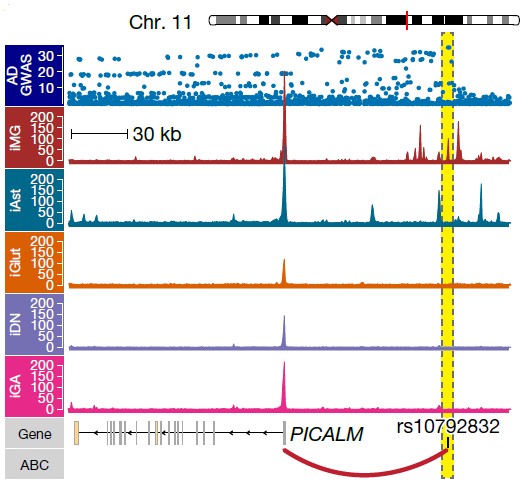
Linking Risk SNPs to Genes. AD risk SNP rs10792832 (yellow bar) affects chromatin structure (peaks) only in microglia (red). This SNP lies in an enhancer that regulates PICALM (red arc). [Courtesy of Kozlova et al., 2025, Nature.]
Duan and colleagues previously developed a method for using assays for transposase-accessible chromatin (ATAC) sequencing to discern the effects SNPs have on DNA packing, and thus on gene expression (Zhang et al., 2020). In the new study, joint first authors Alena Kozlova, Siwei Zhang, Ari Sudwarts, and Hanwen Zhang applied the method to 75 AD GWAS loci. They tested SNPs from each locus in five cell types generated from iPSCs: microglia (iMG), astrocytes, and glutamatergic, GABAergic, and dopaminergic neurons. For 26 of the loci, they found SNPs that altered chromatin structure; 20 of these affected only microglia. About a quarter of the altered chromatin regions were near gene promoters, the rest in enhancer regions.
To determine what genes each SNP affected, the authors used existing activity-by-contact data that links enhancers to target genes (Kosoy et al., 2022). They were able to match nine microglia-specific loci to genes, and chose to follow up on PICALM, one of the strongest risk factors for LOAD. Risk SNP rs10792832 paired with PICALM (image above).
This SNP lies in a binding site of the master microglial transcription factor PU.1, with the G risk allele predicted to weaken binding. The authors confirmed that in iMGs, rs10792832 bound half as much PU.1 as did the non-risk allele, and correspondingly made half as much PICALM.
Because PICALM, aka phosphatidylinositol-binding clathrin assembly protein, promotes endocytosis, the authors investigated whether a dearth of it would hamper phagocytosis. Sure enough, iMGs carrying the risk allele gobbled up only half as much aggregated Aβ. Overexpressing PICALM rescued this defect, while knocking out PICALM in a human microglial cell line mimicked it. PICALM also facilitates lysosomal degradation, and here, too, iMGs carrying the risk allele had problems, with many lysosomal genes suppressed.
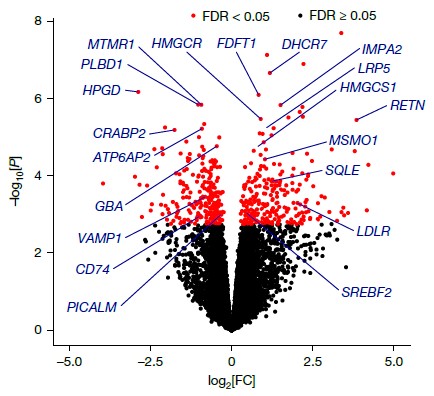
Lipid Disruption. Volcano plot shows the most-altered genes when PICALM is in short supply. More than half of the 20 most affected ones, including DHCR7, HPGD, FDFT1, HMGCR, PLBD1, IMPA2, MTMR1, RETN, ATP6AP2, LRP5, and CRABP2, relate to lipid metabolism. Red dots are statistically significant. [Courtesy of Kozlova et al., 2025, Nature.]
Lack of PICALM had other effects as well. RNA-Seq showed that iMGs carrying the risk allele revved up lipid metabolism genes and made more cholesterol (image above). These expression changes were similar to those previously reported in lipid droplet-accumulating microglia (LDAMs) (Aug 2019 news; Sep 2023 news; Jul 2025 news). In keeping with this, the number of lipid droplets in iMGs carrying the risk allele mushroomed two- to seven-fold. As in LDAMs, reactive oxygen species also doubled. Many lipids became peroxidated, indicating cellular oxidative stress. Overexpressing PICALM soothed microglia, dropping lipid droplets back to normal levels.
Priyanka Narayan at the National Institutes of Health in Bethesda, Maryland, was struck by how much these PICALM phenotypes resemble APOE4 biology, which also involves dysregulated lipids, lysosomes, and phagocytosis, along with accumulation of lipid droplets. “Diverse genetic factors may result in a shared microglial state associated with age or disease,” she speculated (comment below).
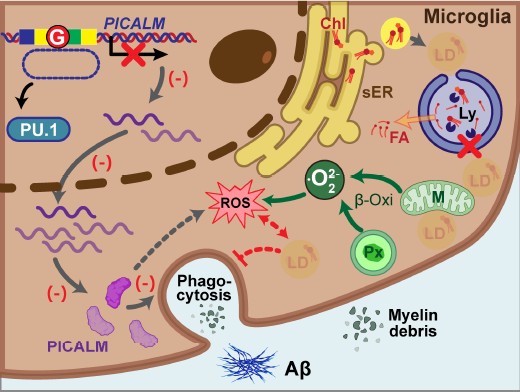
Maladaptive Mechanisms. An AD risk SNP (G) prevents PU.1 binding and turns down PICALM production in microglia. Lack of PICALM (purple) weakens phagocytosis and amps up reactive oxygen species (ROS). This leads to accumulation of lipid droplets (LD), which further harm phagocytosis. Meanwhile, in the endoplasmic reticulum (yellow), cholesterol (red) production ramps up, contributing to LDs, harming lysosomes (Ly), and producing fatty acids (FA). LDs also spur beta-oxidation, exacerbating ROS. [Courtesy of Kozlova et al., 2025, Nature.]
It remains somewhat unclear how all this cell biology relates. The authors suggested that a lack of PICALM exacerbates reactive oxygen species, which in turn hike lipid metabolism and provoke lipid droplet formation, eventually hindering lysosomal function and phagocytosis (image above). Supporting this, they found that the presence of lipid droplets by themselves curtailed phagocytosis in iMGs. However, it could also be that lack of PICALM first impairs phagocytosis and cholesterol uptake, leading to compensatory cholesterol production and lipid droplet formation, the authors noted.
Marcora said the findings support the idea that the main LOAD disease mechanisms relate to the ability of microglia to clear cholesterol-rich debris. “[This] represents a single cellular function that directly links cholesterol metabolism, endolysosomal clearance, and myeloid cells to AD risk,” he wrote. “[It positions] disordered lipid handling in microglia as a central driver of disease vulnerability.”—Madolyn Bowman Rogers.
References
News Citations
- Newly Identified Microglia Contain Lipid Droplets, Harm Brain
- Lipid-Laden, Sluggish Microglia? Blame Aβ.
- Lipid Droplets: Gatekeepers of Microglial Activation, for Better or Worse
Paper Citations
- Zhang S, Zhang H, Zhou Y, Qiao M, Zhao S, Kozlova A, Shi J, Sanders AR, Wang G, Luo K, Sengupta S, West S, Qian S, Streit M, Avramopoulos D, Cowan CA, Chen M, Pang ZP, Gejman PV, He X, Duan J. Allele-specific open chromatin in human iPSC neurons elucidates functional disease variants. Science. 2020 Jul 31;369(6503):561-565. PubMed.
- Kosoy R, Fullard JF, Zeng B, Bendl J, Dong P, Rahman S, Kleopoulos SP, Shao Z, Girdhar K, Humphrey J, de Paiva Lopes K, Charney AW, Kopell BH, Raj T, Bennett D, Kellner CP, Haroutunian V, Hoffman GE, Roussos P. Genetics of the human microglia regulome refines Alzheimer's disease risk loci. Nat Genet. 2022 Aug;54(8):1145-1154. Epub 2022 Aug 5 PubMed.
Further Reading
News
- Stirred by Tau, Neurons Amp Up Lipid Droplets in Glia
- Part with PILRA, Power Up Microglia?
- Expunging Microglial Lipid Droplets Boosts Phagocytosis
- Droplets of Unsaturated Fats Burden Human ApoE4 Astrocytes
- Brain Conference Spotlights Transcriptomics, Therapeutic Strategies
- Neuron-Glia Crosstalk Underlies Senescence, Impaired Lipid Metabolism
- While a Fly Sleeps, Its Glia Burn Neuronal Lipids to Refresh the Brain
- Do APOE4’s Lipid Shenanigans Trigger Tauopathy?
- Can Flipping a Lipid Switch Protect the Brain?
- Cracking the Cholesterol-AD Code: Metabolites and Cell Type
- Do Lipids Lubricate ApoE's Part in Alzheimer Mechanisms?
- ApoE4 Glia Bungle Lipid Processing, Mess with the Matrisome
- Could Greasing the Wheels of Lipid Processing Treat Alzheimer’s?
Primary Papers
- Kozlova A, Zhang S, Sudwarts A, Zhang H, Smirnou S, Byeon SK, Thapa C, Sun X, Stephenson K, Zhao X, Jamison B, Ponnusamy M, He X, Schneider JA, Pandey A, Bennett DA, Pang ZP, Sanders AR, Bellen HJ, Thinakaran G, Duan J. PICALM Alzheimer's risk allele causes aberrant lipid droplets in microglia. Nature. 2025 Sep 3; Epub 2025 Sep 3 PubMed.
Annotate
To make an annotation you must Login or Register.
Comments
Vrije Universiteit Amsterdam
I’m very excited about the findings in this paper as they couple a genetic AD variant in an endocytic protein to changes in lipid metabolism. Overall, I find the results robust, and the IPSC gene-editing and rescue experiments very neatly done. The paper provides strong evidence that PICALM has a major role in lipid metabolism, which might be unexpected for a gene that primarily has been associated with regulation of the endocytic system. Combined with a novel way of defining risk variants, this is a very refreshing story.
The outcomes remind me of the publication by Priyanka Narayan, who, using completely different systems, yeast and induced astrocytes, found that PICALM overexpression can rescue detrimental ApoE4/4 effects (Naryan et al., 2020). While the mechanisms linking PICALM and lipid crosstalk need to be fleshed out, this paper contributes to a view of AD in which endosome-lipid interactions are key in shaping glial immune function and AD risk.
Icahn School of Medicine at Mount Sinai
Genome-wide association studies (GWAS) have identified dozens of common variants that modulate Alzheimer’s disease (AD) risk, but their mechanistic underpinnings are still only partially understood. In this elegant and comprehensive study, Kozlova and colleagues contribute to filling this gap by combining human genetics with functional genomics and experimental studies to reveal how a risk allele at the PICALM locus may modulate disease susceptibility.
Similar to prior work by our group and others, this study shows that risk alleles at AD GWAS loci can act not by altering protein sequence, but by tuning the expression of otherwise broadly expressed genes—such as the endolysosomal genes PICALM and BIN1—in a microglia-specific manner (Huang et al., 2017; Novikova et al., 2021; Nott et al., 2019). Here, the authors demonstrate that the rs10792832 risk allele reduces binding by the transcription factor, and AD risk gene, SPI1/PU.1, which in turn lowers PICALM expression, impairing microglial clearance of amyloid-β and myelin. This is accompanied by transcriptional activation of cholesterol biosynthesis genes, lipid droplet accumulation, and oxidative stress, tying PICALM to the dysfunctional lipid-droplet–accumulating microglia (LDAM) state previously described in aging and APOE4 carriers (Sep 2023 news; Jul 2025 news).
These findings reinforce a hypothesis we have recently proposed: that the three major pathways repeatedly implicated by AD GWAS—cholesterol metabolism, endocytosis/phagocytosis, and the innate immune response (Jones et al., 2010)—are not independent etiological processes, but rather components of a unitary pathogenic hub centered on efferocytosis (Romero-Molina et al., 2022). Efferocytosis is the process by which myeloid cells such as microglia and macrophages phagocytically clear apoptotic cells and other cholesterol-rich cellular debris, including myelin fragments and degenerating neurons. In this way, it represents a single cellular function that directly links cholesterol metabolism, endolysosomal clearance, and myeloid cells to AD risk. The next frontier will be to determine whether the other pathogenetic hallmark of AD, abnormal amyloidogenic processing of APP, integrates into this ensemble as well.
It is also worth recalling that abnormal lipid metabolism in microglia was prominently noted by Alois Alzheimer himself in his first description of the disease, but this observation was almost completely forgotten. Now, more than a century later, AD GWAS and post-GWAS studies like this one are bringing these early insights back to the forefront, positioning disordered lipid handling in microglia as a central driver of disease vulnerability.
National Institutes of Health
This study is a great example of how genomic and functional approaches can be combined to dig into the impact of non-coding SNPs. Using allele-specific open chromatin mapping across a large panel of iPSC-derived cell types, the authors pinpointed a PICALM risk allele that decreases expression by reducing PU.1 binding, with the strongest effects in microglia. In isogenic microglia, reduced PICALM expression impaired phagocytosis, drove lipid droplet accumulation, disrupted lysosomal function, and led to buildup of peroxidated lipids. These defects were rescued by restoring PICALM with CRISPRa and further linked to lipid state using triacsin C, a fatty acid acylation inhibitor.
What’s striking is how much this overlaps with APOE4 biology: impaired phagocytosis (Lin et al., 2018), cholesterol dysregulation (Feringa et al., 2024; Lee et al., 2023; Tcw et al., 2022), lipid peroxidation (Moulton et al., 2021; Windham et al., 2024), lysosomal stress (Gratuze et al., 2023; Guo et al., 2025; Nuriel et al., 2017), lipid droplet accumulation (Haney et al., 2024; Sienski et al., 2021; Stephenson et al., 2025; Victor et al., 2022), and disease-associated gene expression (Green et al., 2024; Keren-Shaul et al., 2017; Sun et al., 2023) all appear in both contexts. Similar signatures are emerging from other disease loci and models (Marschallinger et al., 2020; Podleśny-Drabiniok et al., 2024; Prakash et al., 2025), suggesting that diverse genetic factors may result in a shared microglial state associated with age or disease.
Our past work identified a functional link between APOE4 and PICALM around endocytosis (Narayan et al., 2020), but perhaps this relationship is much broader. Given PICALM’s role as a clathrin-mediated endocytosis adaptor, it’s worth considering whether some of these downstream phenotypes reflect new functions for PICALM or arise from altered trafficking of key substrates, such as cholesterol (via LDLR) or iron (via transferrin receptor). Perhaps perturbations in basic endocytic pathways could ripple into broader metabolic and lysosomal dysfunction.
The use of triacsin C to tie lipid droplets to microglial dysfunction is an important first step. Although it impacts multiple lipid pathways beyond lipid droplet biogenesis, it provides compelling initial evidence for a link between lipids and the many phenotypes discussed. More specific tools will help tease apart whether lipid droplets are causal or just one facet of broader lipidomic disruption.
Overall, this paper shows how a non-coding SNP can be connected to cellular dysfunction in a disease-relevant context and sparks fresh questions about the links between pathways that shape Alzheimer’s risk.
Make a Comment
To make a comment you must login or register.